The Soviet Woodpecker: The Cold War Signal That Nobody Could Explain
Uncover the Cold War mystery of the Soviet Woodpecker signal — a secret radar with a hidden agenda. Explore Duga's strange frequencies, Chernobyl ties, and unanswered questions.
Ham radio operators in the 1970s had a problem. It did not come from bad weather, equipment failure, or sunspot activity. It came from a sound — a hard, mechanical thumping, ten beats per second, cutting through their receivers like someone drumming on a hollow pipe. It showed up in New England bedrooms, English countryside sheds, and Filipino apartments. Nobody could explain it. Nobody owned it. And the more people listened, the stranger it got.
They called it the Woodpecker.
Before we get into why this matters, think about what it would feel like to sit down at your radio, tune into a frequency you use every day, and hear a foreign pulse hammering over everything — a rhythm with no source, no explanation, and no end. That was the daily experience of thousands of amateur radio operators for nearly a decade. Some built custom filters just to block it out. Governments filed formal complaints through international telecommunications bodies. The thumping continued.
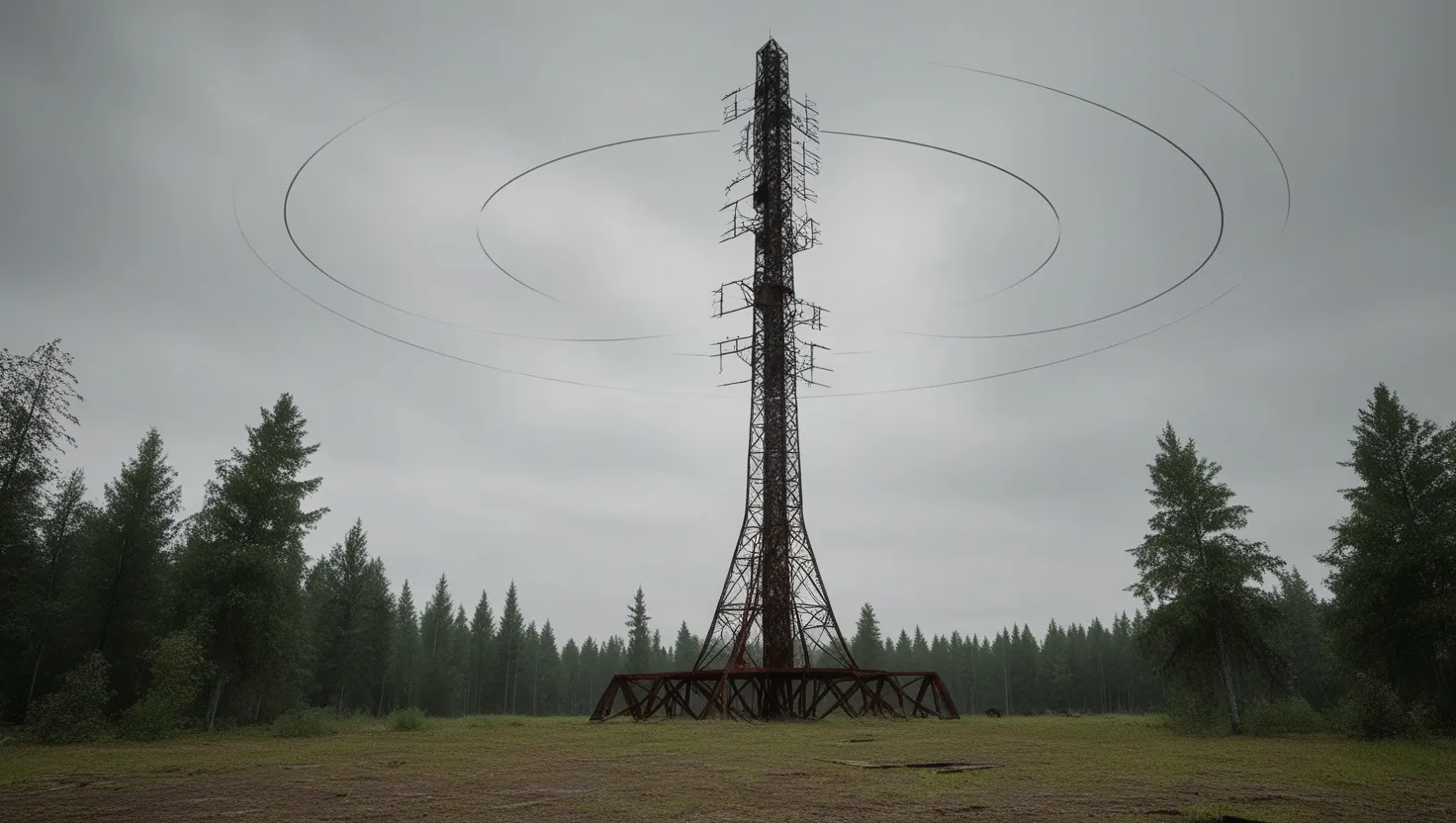
The signal eventually traced back to a Soviet military installation called Duga — a phrase meaning “arc” in Russian. It sat hidden in a forest north of Kiev, inside a restricted settlement called Chernobyl-2, a name that would later mean something entirely different to the world. The antenna structure itself was enormous. Steel towers reaching over 150 meters into the sky, stretching nearly 700 meters in length. You could not miss it from the air. On the ground, it was surrounded by forest, fencing, and secrecy.
The official Soviet purpose was over-the-horizon radar. Standard radar cannot see past the curve of the Earth — a missile launched from the American Midwest is invisible to a radar antenna in Moscow until it is already dangerously close. Over-the-horizon radar solves that problem by bouncing high-frequency radio waves off the ionosphere — the electrically charged upper layer of the atmosphere — and reading the faint reflections that return thousands of kilometres away. In theory, you could detect a missile launch before the missile reached cruising altitude. The thumping was the system’s pulse train: a rhythmic signal sent out and analysed for return echoes.
That explanation is clean. Sensible. Technically elegant. And it probably tells only half the story.
“The most dangerous phrase in the language is ‘we’ve always done it this way.‘” — Grace Hopper
Here is a question worth sitting with: if the only goal was to detect missiles, why use frequencies that overlapped with international civilian bands? Military engineers knew exactly which frequencies the maritime community, emergency services, and amateur broadcasters used. The interference was not an accident of ignorance. It was a deliberate choice — or at minimum, a deliberate indifference. A system designed solely for radar could have operated on frequencies that caused far less disruption. Instead, the Woodpecker planted itself in the middle of global radio traffic and refused to move.
The Soviet government never explained why. And the absence of that explanation is where things get genuinely interesting.
Some researchers noticed that Duga’s pulse rate, hovering near ten cycles per second, sits uncomfortably close to two other known phenomena. The first is the Schumann resonance — a natural electromagnetic frequency generated by lightning discharges bouncing between the Earth’s surface and the ionosphere. The second is the alpha wave rhythm of the relaxed human brain, typically measured between eight and twelve cycles per second. Neither connection proves anything. But in the world of classified Soviet research, those connections were not being ignored.
Soviet military science in the 1970s was already funding serious research into the effects of electromagnetic fields on human behaviour and perception. The program was not fringe science inside the USSR — it had institutional support, laboratory infrastructure, and access to human subjects. The idea that a low-frequency electromagnetic pulse, broadcast at scale across the ionosphere, might affect the nervous systems of populations in targeted regions was taken seriously by people with budgets and clearances.
Did the Woodpecker serve as a live test of that theory? There is no document that confirms it. But listeners reported headaches, unease, and a persistent irritability when the signal was strongest. Most physicians dismissed those claims as nocebo responses — the physical experience of expecting to feel ill. That dismissal may be correct. It may also be convenient.
“In war, truth is the first casualty.” — Aeschylus
There is another angle that rarely appears in popular accounts. Duga was positioned directly next to the Chernobyl nuclear power station — not metaphorically near it, but physically adjacent, sharing infrastructure and power supply. The antenna drew enormous amounts of electricity. A civilian power plant provided that electricity while offering a perfectly innocent explanation for the power lines feeding the complex. No military secret required. Just a power plant, and next to it, a radar.
But a transmitter of Duga’s scale does something beyond sending pulses. It heats the ionosphere. When high-frequency energy of that magnitude strikes the upper atmosphere, it temporarily alters the way that layer transmits and reflects signals. With enough precision, a transmitter could create zones of interference over enemy territory, disrupt communications, or produce effects at the surface through secondary wave interactions. The term researchers use is ionospheric modification — a polite phrase for using the sky as both a mirror and a weapon.
The proximity to a nuclear plant, the deliberate use of civilian frequencies, the pulse rate near known neurological rhythms — taken individually, each is explainable. Together, they suggest that whoever designed Duga was solving more than one problem at the same time.
Ask yourself this: if you ran a secret military program that needed a public cover, what better cover than a radar system that the whole world already knew about? The Woodpecker was the loudest secret in Cold War history. Everyone heard it. Governments complained about it. Engineers built equipment to block it. And because it was so obviously there, nobody looked very hard at what else might have been happening inside that antenna field.
“The most effective way to destroy people is to deny and obliterate their own understanding of their history.” — George Orwell
Then came April 26, 1986. Reactor Number Four at the Chernobyl Nuclear Power Plant exploded. The forest around Duga was contaminated. Chernobyl-2, the secret town that housed the installation’s workers and their families, was evacuated within days. The antenna fell silent — not gradually, not through decommissioning, but because the people who operated it had to leave and never came back.
The Soviet files that were eventually released confirmed the radar’s existence and its official missile-detection purpose. They did not address the frequency choices. They did not address the power consumption anomalies. They did not address the neurological research programs that were running concurrently in other Soviet facilities. Some files remain classified. Others were lost in the administrative chaos that followed the USSR’s dissolution.
The Duga antenna still stands in the exclusion zone today. It is a tourist attraction now, one of the strange prizes people seek when they visit Chernobyl on guided tours. Rust runs down its towers. The forest is reclaiming the ground around it. The structure is too large and too contaminated to dismantle efficiently, so it simply remains — a massive, silent object in a poisoned landscape that asks a question nobody has yet been able to answer fully.
“The trouble with the world is not that people know too little; it is that they know so many things that ain’t so.” — Mark Twain
What the Woodpecker leaves behind is a lesson about how military secrecy actually works. It is rarely complete. The most classified programs produce real-world effects — sounds, heat, interference patterns, sick workers, unusual power draws — that ordinary people notice and record. The secrecy is not about hiding the existence of something. It is about controlling the interpretation of what people are already experiencing.
Ham operators heard the Woodpecker. They documented it, mapped it, argued about it in newsletters and club meetings. They had the raw data. What they lacked was access to the classified layer that would have told them what question that data was answering — or what question it was designed to prevent them from asking.
The signal thumped across the world’s radio spectrum for nearly a decade. It interfered with emergency communications, maritime traffic, and the quiet hobbies of thousands of people who simply wanted to talk to strangers on the other side of the planet. It was answered by complaints, by filters, by jokes, and by folklore. The Soviet government said nothing useful. The antenna disappeared into a radioactive forest. And the ten-beat pulse became one of the great unexplained rhythms of the Cold War — not because nobody heard it, but because hearing something and understanding it are two entirely different things.