5 Ancient Civilizations That Vanished Without Explanation — And Still Puzzle Experts Today
Explore five ancient civilizations that vanished without explanation — from the Bronze Age collapse to Angkor. Uncover the mysteries archaeologists still can't solve.
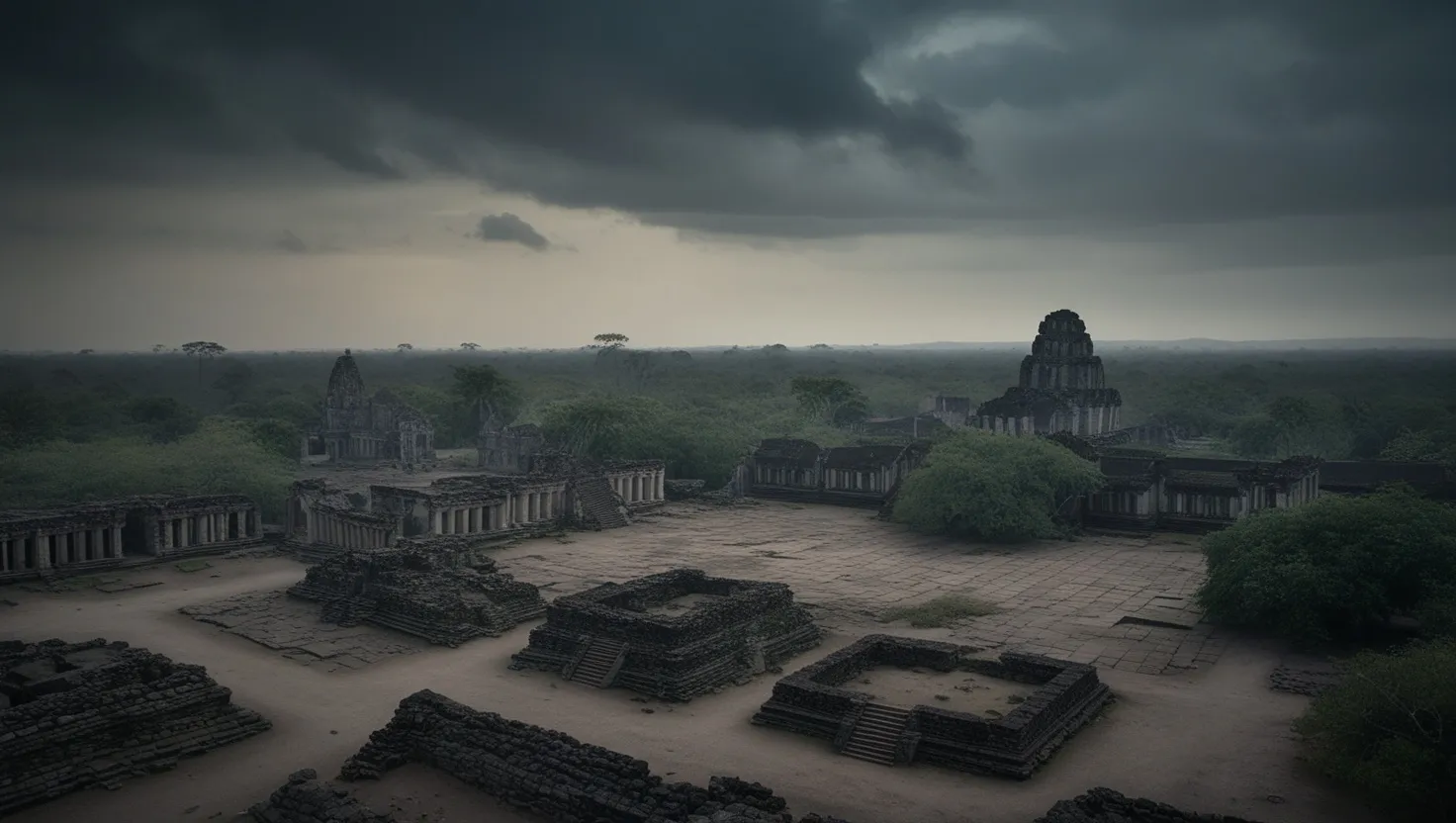
There is something deeply unsettling about a city going quiet. Not bombed into rubble, not conquered by a foreign army, not swept away by a volcano. Just… quiet. People stopped coming. The markets closed. The priests left the temples. And nobody wrote down why.
History loves a dramatic ending. We like our civilizations to go out with a bang — Rome sacked by Visigoths, Carthage salted into the earth, Pompeii buried in ash. But some of the most sophisticated societies that ever existed simply stopped existing, and they left us no explanation. No farewell letter. No final entry in the records.
These are the ones that keep archaeologists awake at night.
“The past is never dead. It’s not even past.” — William Faulkner
Think about what it takes to build a city. You need organization, food surplus, specialized labor, trade networks, political will, and generations of accumulated knowledge. Now imagine all of that just… stopping. That is what happened to at least five major civilizations across different continents and different centuries. And we still do not know the full story of why.
Let me take you through them — not as dusty museum exhibits, but as real human puzzles that nobody has fully solved.
Around 1200 BCE, the Bronze Age Eastern Mediterranean was the most interconnected world that had ever existed. The Hittites in Anatolia, the Mycenaeans in Greece, the Egyptians in the south, the Ugaritians on the Syrian coast — they traded with each other, wrote letters to each other’s kings, and shared technologies. Then, within a few decades, almost all of them collapsed simultaneously.
Ugarit, one of the great trading cities of the ancient world, was destroyed so suddenly that a tablet was found in the kiln, half-baked, with a desperate message: a king begging for soldiers because enemy ships had appeared offshore. The letter was never sent. The city was never rebuilt.
The culprits in most history books are the “Sea Peoples” — a mysterious confederation of migrants or raiders who appear in Egyptian records and are blamed for much of the destruction. But here is the strange part: nobody knows where the Sea Peoples actually came from. Some researchers think they were climate refugees from failed harvests. Others think they were displaced Mycenaeans themselves. A few believe the whole “Sea Peoples” explanation is a scapegoat, and that the real causes were drought, internal trade collapse, and political fragmentation happening all at once.
What we know for certain is that palace economies across the region simply switched off. Writing systems vanished. Trade routes closed. Greece entered a period sometimes called the “Dark Ages” where literacy itself disappeared for centuries.
Can you imagine an entire society forgetting how to read and write? That is what happened. And nobody recorded the moment it occurred, because by then, there was nobody left who could.
“The more original a discovery, the more obvious it seems afterward.” — Arthur Koestler
Now move east. Way east. To what is now Pakistan and northwest India, where the Indus Valley Civilization built cities between roughly 2600 and 1900 BCE that were, by any measure, astonishing. Mohenjo-daro and Harappa had standardized brick sizes across hundreds of miles of territory — which implies a level of central planning that would be impressive even by modern standards. They had indoor plumbing. Sewage systems. Grid-planned streets.
Here is what makes this civilization so haunting: there are no palaces. No royal tombs. No massive monuments to powerful kings. No war art. No images of battles or conquered enemies. The Indus Valley people either had no warrior class, or they simply chose not to celebrate violence. We genuinely do not know which.
And then they left. Slowly, over a few centuries, the great cities emptied out. People migrated east and south. The cities were not burned. There are no mass graves indicating plague or massacre. The writing system — which has still not been deciphered — just stopped being used.
Ask yourself this: what kind of civilization leaves behind no single readable word, no identifiable king’s name, no war record — and then quietly disappears? We have thousands of their seals, their pottery, their jewelry, their careful urban engineering. We just cannot hear their voice.
The most widely accepted theory today points to climate change — specifically, a monsoon weakening that reduced the river systems the cities depended on. But even this explanation feels incomplete. Other civilizations have survived droughts. The Indus people did not fight back, did not rebuild on higher ground, did not leave emergency records. They just went.
The Maya collapse is probably the most debated archaeological mystery of the last hundred years. And the frustrating thing is that the Maya did not collapse. Not entirely. The Maya people are still here, in the millions, in Mexico and Guatemala and Belize. Their descendants are alive, speaking Mayan languages, maintaining traditions. What collapsed, around 800 to 900 CE, was the political and urban structure of the southern lowland cities.
Cities like Tikal, Palenque, and Caracol — which had populations in the hundreds of thousands and produced extraordinary art, astronomy, and architecture — were abandoned within a few generations. The last dated monuments in the lowland cities come from around 910 CE, and then nothing.
Researchers have proposed war between city-states, drought, deforestation, peasant revolt, epidemic disease, and combinations of all of the above. The drought evidence is now fairly strong — lake sediment cores show severe dry periods in the 9th century. But why didn’t some cities survive while others failed? Why didn’t the Maya simply relocate their centers, as some northern cities like Chichen Itza actually did?
The honest answer is that we are working backward from ruins, and ruins are imperfect narrators.
“Civilizations die from suicide, not by murder.” — Arnold Toynbee
Cahokia is the one that most Americans do not even know existed. Located across the river from modern St. Louis, it was, around 1100 CE, the largest city north of Mexico. Its population has been estimated at anywhere from 10,000 to 20,000 people — comparable to contemporary London. It had a massive central mound larger than the base of the Great Pyramid of Giza. It had a circular calendar made from wooden posts. It had long-distance trade reaching from the Gulf of Mexico to the Great Lakes.
Then it emptied out. By 1350 CE, Cahokia was essentially abandoned. There was no European contact yet to blame. No smallpox. No conquistadors. The people who built it — the Mississippian culture — left, and the city returned to grass and trees so completely that early European settlers had no idea they were walking through the ruins of a major metropolis.
What is quietly remarkable about Cahokia is the evidence of internal tension. Some researchers have found signs of human sacrifice, elite control of food resources, and possible forced labor — suggesting a society under significant internal strain long before its end. The people may have voted with their feet, walking away from a system that had stopped working for them. If that is true, it is one of the most quietly radical acts in human history.
Angkor, the capital of the Khmer Empire in what is now Cambodia, is the most visually spectacular of these vanished worlds. At its height around 1200 CE, it was one of the largest pre-industrial cities on Earth, with a population possibly exceeding one million people supported by an intricate network of canals, reservoirs, and rice paddies.
Its decline was not a single event but a slow unwinding across two centuries. Researchers now point to the hydraulic infrastructure itself as both Angkor’s greatest achievement and its eventual weakness. The water management system that fed the city became so complex that maintaining it required enormous labor. When the system began to fail — partly due to climate shifts, partly due to silting and poor maintenance — the city became untenable.
The Khmer court relocated to the coast in the 15th century, and the jungle began its patient work on the stone temples. What strikes me about Angkor is that its fall was not dramatic. It was administrative. Bureaucratic, even. The paperwork of empire became too heavy to carry, and the people simply stopped.
“We shall not cease from exploration, and the end of all our exploring will be to arrive where we started and know the place for the first time.” — T.S. Eliot
What connects all five of these civilizations? No single cause. No common enemy. No shared weakness. What they share is the absence of a recorded ending — no scribe sat down and wrote “today our city ends.” They share the human tendency to keep functioning right up until the moment functioning becomes impossible.
They also share something more personal. They built things meant to last. The Indus Valley engineers who standardized their bricks. The Maya astronomers who calculated planetary cycles centuries into the future. The Cahokian mound builders who moved millions of cubic feet of earth with their hands. These were not people who expected to disappear.
Every civilization probably believes, at some level, that it will not be the one that ends. That is worth sitting with quietly for a moment.