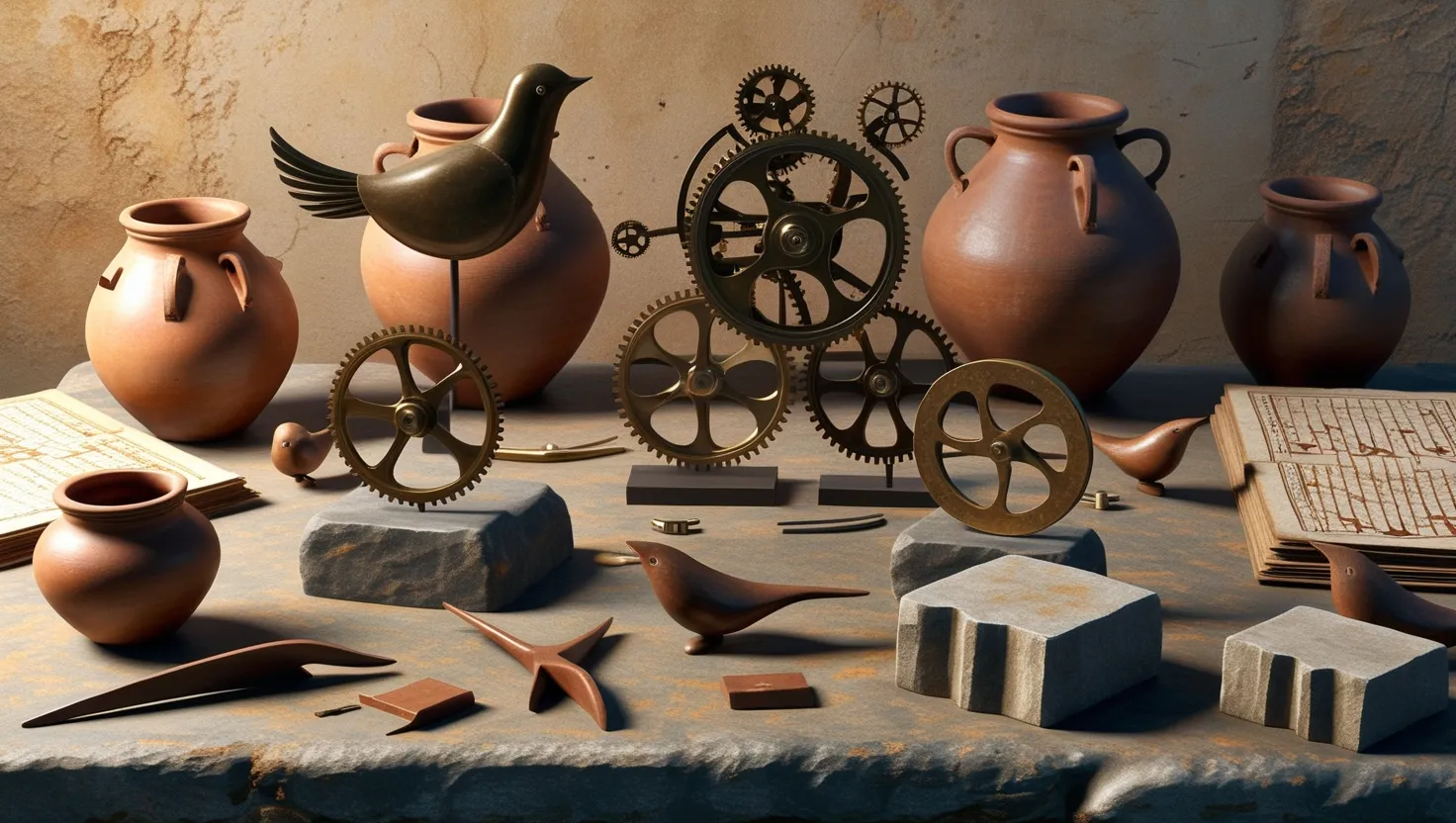
Let’s talk about some old things that really shouldn’t exist. Not in the way that makes you say “Wow, that’s cool,” but in the way that makes you pause and go, “Wait… how did they even do that?” These aren’t just ancient tools or pretty statues. These are objects that look like they slipped through time from a much later era. Things so advanced, so precise, that they make modern engineers scratch their heads and wonder if we’ve got history completely wrong.
Imagine this: you’re diving off a rocky Greek island, hunting for sponges, and instead you find a shipwreck full of statues, jewelry, and a lump of greenish rock that looks like someone left a bronze sandwich in the sea for 2,000 years. That lump turns out to be a clockwork machine with tiny gears, dials, and inscriptions that predict eclipses, track the moon’s weird wobble, and even follow the Olympic Games. That’s the Antikythera mechanism. And no, it’s not a movie prop. It’s real. And it’s from around 100 BCE.
Now, picture a small clay jar from ancient Mesopotamia, maybe 2,000 years old. Inside it, there’s a copper cylinder, an iron rod, and some kind of acidic goo. Put it together, and it can produce a tiny bit of electric current. That’s the Baghdad Battery. Was it used to electroplate jewelry? To power some forgotten ritual device? Or is it just a coincidence that looks like a battery? We don’t know. But it’s strange enough that people still argue about it.
Then there’s the Saqqara Bird. Found in an Egyptian tomb, it looks like a little wooden bird with wings. But the wings are shaped in a way that’s eerily similar to a modern glider. Some say it’s just a toy. Others say it’s proof that the Egyptians understood aerodynamics long before the Wright brothers. I’m not saying they had airplanes, but I am saying that if you handed this to an aerospace engineer and said “figure out what this is,” they might not jump straight to “bird statue.”
Think about the precision of some ancient stone blocks. In places like Puma Punku in Bolivia or the temples of Egypt, you’ll see stones weighing tons, cut so perfectly that you can’t slide a credit card between them. The edges are straight, the angles are exact, and some of the holes look like they were drilled with machines, not chisels. How did people with copper tools and stone hammers achieve that kind of accuracy? Did they have tools we don’t know about? Or did they have knowledge that got lost and never written down?
There’s also the Lighthouse of Alexandria. We know it existed because ancient writers described it, but the details are fuzzy. What’s clear is that it was massive, standing hundreds of feet tall, and it used mirrors to focus sunlight so ships could see it from far away. That’s not just a big tower. That’s an early example of using optics and engineering on a scale that wasn’t matched for centuries. How did they design it? How did they build it without modern cranes or computers? And why don’t we have more examples of this kind of thinking from that time?
Another odd one is the Dendera Light. It’s a relief in an Egyptian temple that shows figures around what looks like a giant light bulb with a filament and a cable. Mainstream archaeology says it’s a symbolic depiction of a lotus flower and a snake, but the resemblance to a modern light bulb is uncanny. Could it be that the Egyptians had some kind of electrical knowledge? Or is it just a case of our brains seeing patterns where there aren’t any? Either way, it’s hard to look at it and not wonder.
And then there’s the Voynich Manuscript. A book written in a language no one can read, filled with plants that don’t exist, and diagrams that look like alchemical or astronomical charts. It’s been studied by cryptographers, linguists, and computer scientists, and still, no one can crack it. Is it a hoax? A lost language? A coded message from a secret society? Or something else entirely? The fact that it’s survived this long without being understood is itself a kind of technological mystery.
What ties these things together isn’t that they’re all “proof” of aliens or lost civilizations, though people love to say that. What ties them together is that they don’t fit neatly into the story we tell about progress. We like to think of history as a straight line: simple tools, then better tools, then machines, then computers. But these artifacts are like glitches in that timeline. They’re outliers. They’re the exceptions that make you question the rule.
Take the Antikythera mechanism again. It’s not just a few gears slapped together. It’s a complex system where one gear drives another, which drives another, all working together to model the motions of the moon and planets. The math behind it is sophisticated. The way it accounts for the moon’s uneven speed? That’s not guesswork. That’s advanced astronomy turned into mechanical engineering. And it was made over 2,000 years ago, in a world without factories, without precision lathes, without even the concept of a modern gear train.
Now, here’s a thought: maybe the real mystery isn’t the artifact itself, but why we don’t see more of them. If the Greeks could build something like the Antikythera mechanism, why aren’t there dozens of similar devices? Why didn’t this kind of technology spread and evolve? Was it a one-off? A prototype? Or was it part of a broader tradition that got wiped out by war, fire, or time?
“Any sufficiently advanced technology is indistinguishable from magic.”
— Arthur C. Clarke
That quote hits different when you’re looking at a 2,000-year-old gear system that predicts eclipses. To the people of that time, this thing must have seemed like magic. To us, it’s a puzzle. But maybe the real magic is in the human mind that designed it.
Let’s talk about materials for a second. Some ancient artifacts are made from materials that shouldn’t have been available at the time. There are reports of metal alloys in old Chinese bronzes that match modern specifications, or of ancient Indian texts describing metals and processes that sound suspiciously like advanced metallurgy. And then there’s the question of how they worked those materials. Some stone objects show signs of being cut with tools that rotate at high speed, leaving marks that look more like they came from a lathe than a chisel. How did they do that? Did they have some kind of primitive machine tools? Or did they use techniques so different from ours that we can’t even recognize them?
Another angle: what if some of these “outliers” weren’t meant to be practical at all? What if they were teaching tools, ritual objects, or even early forms of art and science combined? The Antikythera mechanism might not have been a mass-produced device. It could have been a one-of-a-kind demonstration piece, like a modern planetarium built for a king or a temple. That would explain why we don’t find more of them. They weren’t everyday tools. They were special.
And what about the people who made them? We tend to think of ancient craftsmen as simple laborers, but some of these objects suggest highly specialized knowledge. Someone had to understand astronomy, mathematics, and mechanical engineering to build the Antikythera mechanism. Someone had to know how to shape stone with incredible precision at Puma Punku. Someone had to design the Baghdad Battery, whether it was for electroplating or something else. These weren’t random accidents. They were the work of skilled minds.
So why don’t we give them more credit? Why do we default to “they must have had help” instead of “they were smarter than we thought”? Maybe it’s because it’s easier to imagine aliens or lost super-civilizations than to admit that ancient people were capable of things we still don’t fully understand.
Here’s a question: if you found a modern smartphone in a 2,000-year-old tomb, would you assume it was planted there? Or would you start rethinking everything you know about history? The artifacts we’re talking about aren’t quite that extreme, but they’re close enough to make you pause.
And let’s not forget the role of chance. Many of these objects survived because they were buried, submerged, or hidden. The Antikythera mechanism was underwater. The Baghdad Battery was in a sealed jar. The Voynich Manuscript was tucked away in a library. If they’d been left out in the open, they might have been destroyed, recycled, or lost. So the fact that we have them at all is partly luck. Which means there could be other artifacts, just as strange, that we’ll never see.
What if the real outlier isn’t the artifact, but our expectation of what ancient people could do? We assume that progress is linear, but what if it’s more like waves? High points, low points, lost knowledge, rediscovered ideas. Maybe the Antikythera mechanism wasn’t a fluke. Maybe it was the peak of a wave that later receded, leaving only fragments behind.
Think about how much knowledge we’ve lost even in recent history. Old manufacturing techniques, forgotten recipes, traditional medicines, entire languages. Now imagine that on a much larger scale, over thousands of years. It’s not hard to believe that some advanced ideas or technologies could have existed and then disappeared without a trace.
So when you look at these strange old objects, don’t just ask “Who made this?” Ask “What else did they know?” Ask “What else did they build that didn’t survive?” Ask “What if we’re not the first civilization to reach this level of complexity?”
These artifacts don’t prove that history is wrong. But they do prove that it’s incomplete. They’re like footprints in the sand, leading in directions we didn’t expect. And the more we study them, the more we realize that the past is not just a simpler version of the present. It’s a place full of surprises, full of people who were just as curious, just as clever, and just as capable of pushing the limits of what’s possible.
“History is not a burden on the memory but an illumination of the soul.”
— Lord Acton
Maybe that’s the real value of these technological outliers. They don’t just challenge our timelines. They remind us that human ingenuity has always been there, in all kinds of forms, in all kinds of places. And if people 2,000 years ago could build something like the Antikythera mechanism, what else might they have done that we just haven’t found yet?
Next time you see a picture of an ancient statue or a temple, don’t just see the obvious. Look for the details. Look for the precision, the materials, the little things that don’t quite fit. Because sometimes, the most important part of history isn’t the big story. It’s the small, strange object that makes you stop and say, “Wait… how did they do that?”