Ever wondered if there’s a boundary we can never cross, no matter how advanced our technology gets? Spoiler: there is. Even with the most advanced sci-fi tech, we’re trapped in a limited pocket of the universe. But just how big is this pocket, and how far can we venture into space?
When you gaze at the night sky, it seems eternal. Stars are born, live, and die in a never-ending cycle. Yet, that’s just an illusion. Take our home, the Milky Way: it’s about 200,000 light-years in diameter and has around 100 to 400 billion stars. But here’s a shocker – only three new stars are born each year! That’s because we’re living at the tail end of star formation. Almost 95% of the stars that will ever exist have already been born. We’re at the beginning of the end of our universe as we know it.
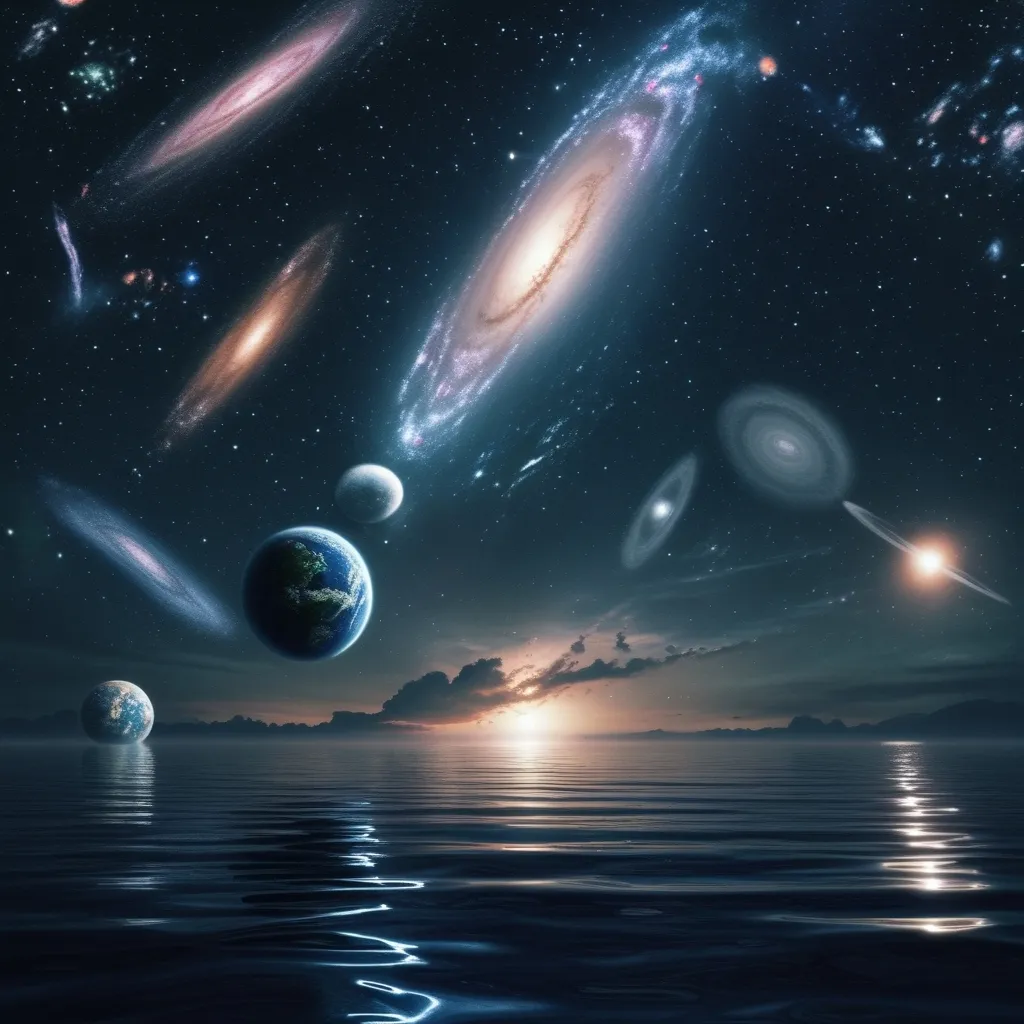
To add to the drama, our universe is expanding and rushing away from us. The Milky Way is part of a local group with the Andromeda galaxy and over 50 dwarf galaxies within a 10 million light-year diameter. This group is just a drop in the cosmic ocean. There are about 2 trillion galaxies in the observable universe, but 94% of them are out of our physical reach forever, even at light speed.
Why are these galaxies beyond our reach? It all started with the Big Bang about 13.8 billion years ago. After the Big Bang, the universe expanded rapidly in a phase known as cosmic inflation. This made the universe consist of denser and less dense regions due to tiny variations. Gravity began working on these dense pockets, pulling them into galaxies we see today.
Our local group is one of these denser pockets. However, outside these pockets, space never stops expanding, making the universe continuously grow larger. And it’s accelerating! This phenomenon, driven by a mysterious force called dark energy, means galaxies beyond a certain point are moving away faster than the speed of light relative to us.
So, what about those 94% of galaxies we can see but can never touch? That seems cruel, right? We still see their ancient light because it started its journey to us when those galaxies were much closer. We’re essentially looking at a cosmic time machine. But as the universe keeps expanding, even the closest of these galaxies will eventually fade into darkness, crossing a cosmological horizon where we cannot see or interact with them ever again.
Right now, we look at the cosmos and see a grand show. The observable universe is like a time capsule of ancient light, continually shrinking in what we can physically reach. The segments within 18 billion light-years are still in reach, theoretically. Yet, even a super-advanced civilization would struggle to travel these colossal distances.
The local group is probably the biggest structure humanity will ever call home. In the far-off future, it will coalesce into one giant galaxy named Milkdromeda. For now, we have at least a few billion years to explore our cosmic backyard, a mere speck in the grand scale of the universe.
Despite the eventual isolation, we’re living in the perfect era to glimpse both our future and our most distant past just by looking up at the sky. Sooner or later, the local group may become a secluded island in the vast, dark ocean of the universe.
As we ponder our small place in this vast universe, it’s an incredible privilege to exist at this fleeting moment in cosmic history. The stars we see today are part of a spectacular home, and while we may never reach most of the universe, what we have is more than enough to explore for many lifetimes.