Can We Turn Mars into a Living Paradise with Giant Lasers?
Turning the Red Planet Green: Humanity's Next Bold Adventure
Mars might seem like an unwelcoming place, but transforming it into a livable, green world is more than a science fiction dream. We could actually terraform Mars, though it involves making things worse before they get better. Imagine turning the planet’s surface into oceans of lava using gigantic lasers. Surprisingly, this idea isn’t as far-fetched as it sounds and could happen within a time frame similar to the construction of ancient monuments.
The process begins with dealing with Mars’ many challenges. The planet is dry, has no soil for growing plants, and its atmosphere is too thin to support human life or shield against radiation. To make it hospitable, Mars needs a breathable atmosphere, similar to Earth’s. This includes 21% oxygen, 79% nitrogen, and a bit of CO2, along with an average temperature of 14°C and 1 bar of pressure. We’d need to create oceans and rivers, transform the ground into fertile soil, and establish a lasting biosphere.
Here’s where the big lasers come in. Mars used to have an atmosphere rich in oxygen and was home to vast bodies of water. But it all disappeared due to ultraviolet rays and solar wind. Fortunately, a lot of the water and oxygen is still bound in the planetary rocks and polar ice caps. To free these elements, we would essentially melt Mars’ surface by using lasers to reverse the chemical reactions holding them.
The idea is to deploy powerful lasers, like a supercharged version of the ELI-NP, to hit Mars’ surface, releasing oxygen and carbon dioxide from the rocks. We’d need a solar-pumped laser to power this. If we concentrate sunlight using an array of mirrors in space, we can generate the necessary energy to melt Mars.
As the ground melts, it releases gas and creates a chaotic landscape of storms, red-hot areas, and lava flows. The polar ice caps would turn into steam, forming clouds that rain down and eventually form salty oceans. This lasering would need to continue for about 50 years, creating an atmosphere that’s almost all oxygen.
To make it breathable and safe, we’d need a lot of nitrogen, which Mars lacks. The best source is Titan, Saturn’s moon, full of nitrogen. By constructing automated factories on Titan and shooting nitrogen-filled tanks to Mars, we could import the necessary nitrogen to mix with the oxygen.
After about a century, we’d have an atmosphere ready for life, but Mars would still look like a desolate wasteland. To make it vibrant, we’d need to develop a biosphere. This starts by introducing phytoplankton in the oceans, followed by zooplankton and fish. Creating fertile land is trickier, but by using the lasers to break down the surface and adding water, we can create a sort of mud that supports fungi and bacteria. These, in turn, help plants grow.
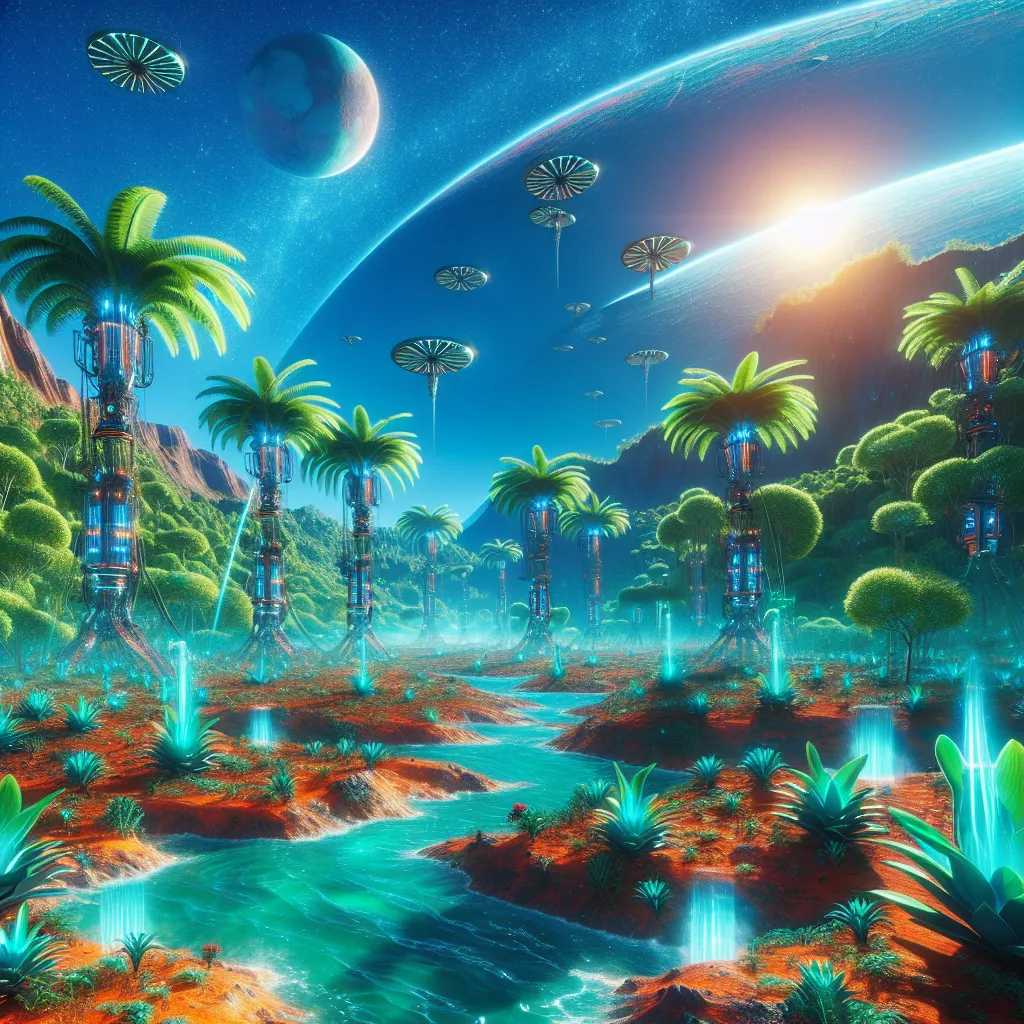
We’d begin with hardy plants from volcanic islands on Earth and eventually build up to more complex ecosystems, including trees, grasslands, and forests. This would require careful maintenance and a long time to balance, but slowly, Mars would turn green.
There’s a crucial problem: without a magnetic field, Mars wouldn’t be protected from solar radiation. So, we’d need to create an artificial magnetic field using a large superconducting ring in space, shielding Mars from harmful winds.
Terraforming Mars is a massive endeavor, requiring significant resources, time, and innovation. But achieving it would mark humanity’s first step toward living among the stars, shaping a new home uniquely by us and for us.