Could the Universe's Biggest Supergun Be Aiming at Us Right Now?
Galactic Death Rays: The Unseen Threat from Beyond
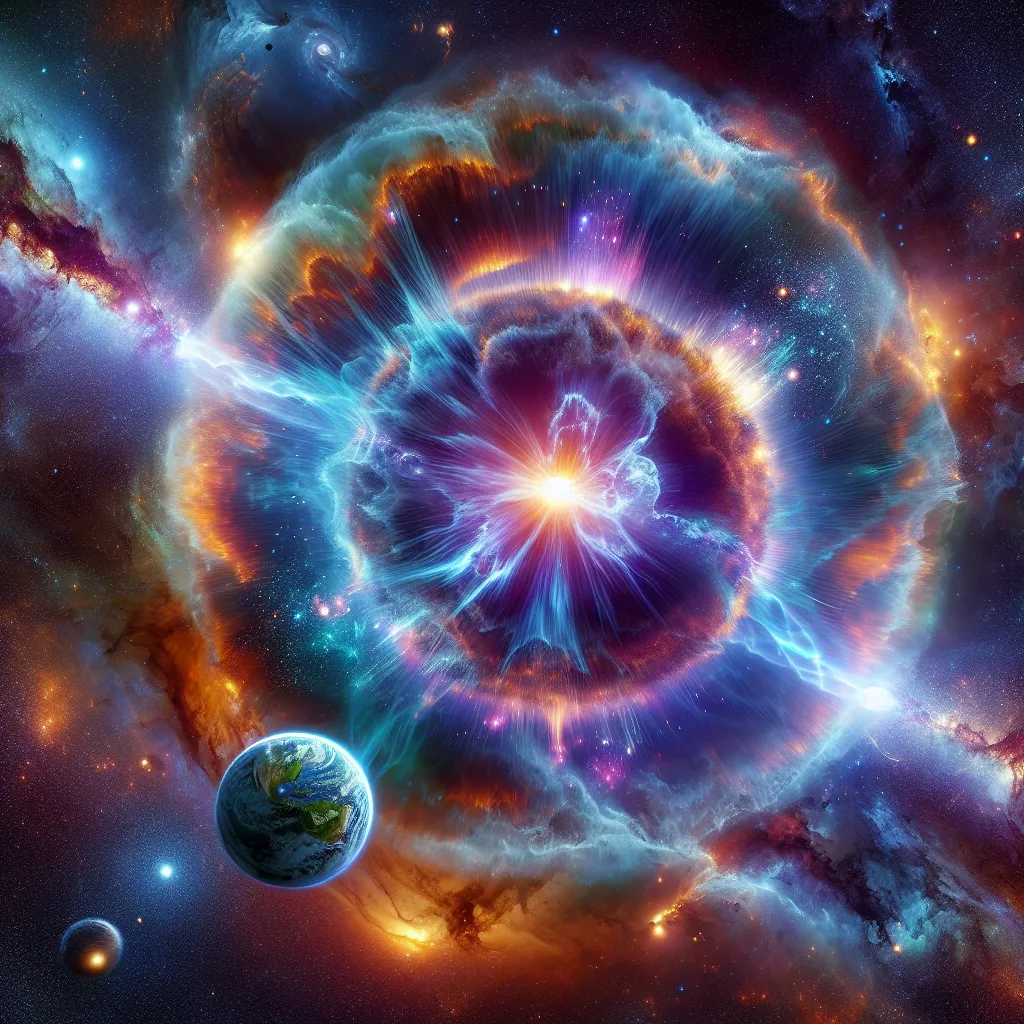
Imagine harnessing the energy from every star within a hundred million light years across thousands of galaxies. That’s a mind-blowing amount of power! Now, imagine channeling all that energy into the universe’s biggest super-weapon. Actually, you don’t have to imagine. They’re called gamma ray bursts (GRBs), and they exist right now. So, what are these cosmic snipers, and what would happen if one targeted Earth?
First, let’s break down what gamma rays are. Gamma rays are a type of electromagnetic radiation, much like visible light but vastly more energetic. A single gamma ray photon packs more punch than a million visible-light photons put together. This makes gamma rays highly ionizing, meaning they can break atomic bonds and are dangerous to living beings.
Here on Earth, we’re protected by the ozone layer, which blocks these harmful gamma rays. But how did we even discover GRBs, if they’re mostly blocked from reaching us? During the Cold War, U.S. spy satellites were sent to detect gamma rays from Soviet nuclear tests in space. While they didn’t find any bombs, they stumbled upon mysterious, fleeting bursts of gamma rays coming from outer space.
Astronomers got involved, using various telescopes to make sense of these bursts. After three decades, they pinpointed a source: a galaxy six billion light years away. To be visible from such a distance, GRBs must release an insane amount of energy— more in a single second than the sun will in its entire ten billion-year lifetime!
So, where do these bursts come from? They are tied to some of the most violent events in the universe, including the birth of black holes. There are two types of GRBs: long and short. Long GRBs, which last about a minute, usually come from supernovae when a massive star’s core collapses into a black hole. Short GRBs, lasting just a second, occur when two neutron stars merge and form a black hole.
Both of these catastrophic events create gas disks that magnetically funnel particles at nearly light speed. This process produces two focused jets of gamma rays, like intergalactic laser beams.
We know GRBs happen frequently, but most are far enough from Earth to be harmless. We detect around one per day on average, none from within our Milky Way that could hurt us. However, if a GRB hit close enough—say, within a few light years— it could wreak havoc, potentially sterilizing the Earth’s surface.
Even a more distant GRB could still spell disaster. A GRB a few thousand light years away would spread out to cover a hundred light years by the time it reaches us. This vast wave of radiation could deplete our ozone layer, leaving us exposed to the deadly ultraviolet rays from the sun. Ozone takes years to recover, enough time for the sun to scorch the Earth and eliminate much of its complex life.
Some scientists even theorize that a GRB may have caused the Ordovician extinction 450 million years ago, wiping out 85% of marine species. It’s hard to prove, but it shows the potential danger of these cosmic events. They might even be a reason we don’t see life elsewhere in the universe; GRBs could be resetting the game board, erasing chunks of life periodically.
So, should we worry about GRBs wiping us out? Probably not. In a galaxy like ours, a dangerous GRB happens maybe once every thousand years. For one to harm us, it would need to happen nearby and aim directly at Earth. But since gamma rays travel at light speed, we wouldn’t see it coming— we’d only know when it’s too late. So, there might already be a GRB on its way to end humanity, but the bright side is, we won’t have time to worry about it.