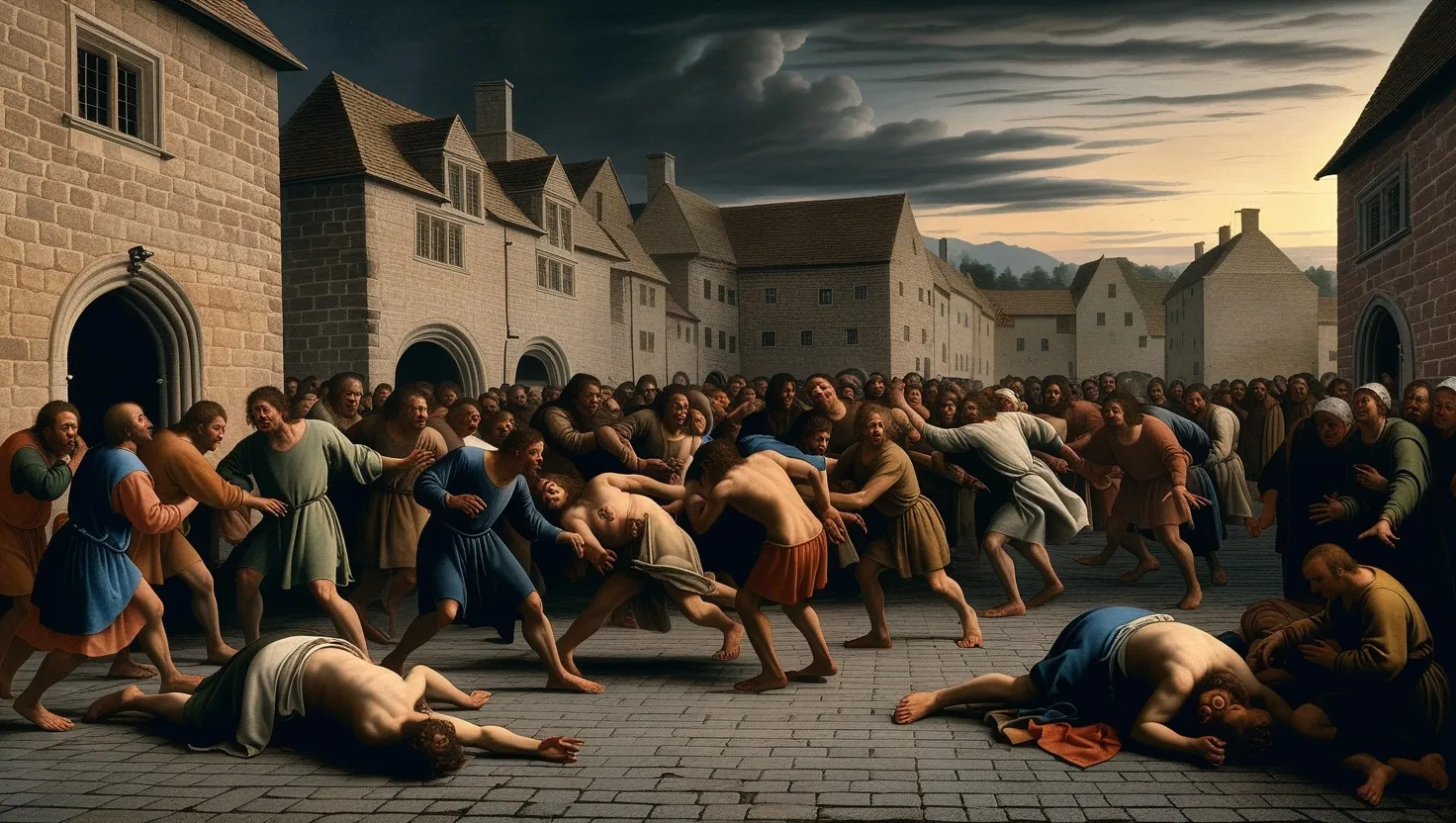
In the summer of 1518, in the city of Strasbourg, a woman stepped into the street and started to dance. She did not stop after a song. Or an hour. Or a day. She kept going for days, shaking and turning until her feet bled. Then something stranger happened: other people joined her. Dozens, then maybe hundreds, moved as if pulled by invisible strings, dancing until they collapsed. Some never got back up.
I want you to picture that very clearly. Not a happy festival. Not a party. Imagine people crying while their legs keep moving. Imagine families trying to hold someone still while that person’s body fights to get back to its feet. Does that feel like fun, or like a nightmare?
At first glance, the story sounds almost funny, like a weird medieval joke. But the more we look at it, the more it becomes a powerful window into how fragile the human mind and body can be, especially when life is hard and fear never stops.
As one writer famously said:
“We are more often frightened than hurt; and we suffer more in imagination than in reality.”
In Strasbourg, imagination and fear may have been strong enough to make bodies dance against their own will.
Let me walk you through what likely happened, in the simplest way possible, and then we will explore what makes this event so disturbing and so useful for understanding people today.
First, the basic story. Around July 1518, a woman often called Frau Troffea started dancing in the street. She did not seem drunk or cheerful. She looked driven, almost forced. People watched. The next day, she was still at it. Day after day, she kept moving. Her husband could not stop her. Neighbors could not stop her. You know how, if one person laughs loudly, others start laughing too, even if they do not know why? Something like that may have happened, but far more intense.
Within a week, dozens joined her. Within a month, reports say there were up to four hundred people dancing. Imagine a busy town square where instead of people walking, buying food, talking, you see bodies constantly moving, sweating, shaking, swaying, some praying, some screaming. No music at first. Just feet and panic.
Now here is a question to pause on: if you saw a crowd doing something strange and scary, would you feel pulled to join, or pulled to run away?
The authorities of Strasbourg were not dumb. They were scared. When leaders are scared, they often do something that makes things worse while trying to help. That is exactly what seems to have happened here.
At first, local doctors said this was not demons or magic. They said it was a “natural” problem of “overheated blood.” Their idea of treatment was, in modern terms, “let them get it out of their system.” So they ordered spaces to be cleared, even built stages, brought in musicians and hired professional dancers to keep these people moving. Picture that: a city, in crisis, trying to cure dancing by adding more dancing.
If you have ever fed a fire with more wood, you know what happened next. The “cure” made things worse. More people joined in. The behavior became more visible, more dramatic, and probably more attractive to anyone already on the edge emotionally.
Later, when that plan failed, the city tried the opposite approach. They sent the worst cases away to a shrine for Saint Vitus, a saint people believed could both curse and heal through dance. There, priests guided them through a ritual. They gave them red shoes, marked with crosses, sprinkled holy water, chanted prayers. Over time, the strange dancing faded.
Now, the obvious question: what on earth caused this?
The honest answer is: we do not know for sure. But we do have several strong ideas, and each of them tells us something interesting about how humans behave.
One old idea is that bad food poisoned them. People at the time often ate rye bread. Sometimes, a fungus called ergot grows on rye. This fungus can produce chemicals a bit like LSD. These chemicals can cause strange thoughts, spasms, and even visions. You may have heard a similar theory about the Salem witch trials.
This sounds tidy: bad bread, weird behavior, case closed. But there is a problem. Ergot poisoning usually causes painful muscle contractions, not rhythmic, organized dancing for days. It can also be deadly quite fast. It does not normally cause hundreds of people to move in the same dramatic way over weeks. So while bad grain might have harmed some people, it probably does not explain the whole crowd.
Another idea is that this was a form of religious or spiritual behavior gone out of control. In that time, some people believed that certain saints, especially Saint Vitus, could punish sinners by making them dance. Also, dancing processions were not completely unknown in that region. In earlier centuries, groups had marched and moved together during times of fear and crisis, sometimes calling it a curse, sometimes a plea for mercy.
Ask yourself this: if you already believe a saint can force you to dance as punishment, and your life is full of hunger, disease, and fear, how easy would it be for your brain to turn stress into movement without your conscious choice?
This leads to the theory many modern historians and medical experts find most convincing: mass psychogenic illness, sometimes called mass hysteria. That phrase sounds insulting, but it is not meant to be. It simply describes a situation where a group of people, under intense shared stress, start showing real physical symptoms that spread through suggestion, fear, and expectation, rather than through a germ or poison.
Here is a key point: these people were not “faking it.” Their bodies were responding to real fear, pain, and hunger. Their minds turned inner stress into outer movement. If a culture expects a certain kind of reaction to extreme stress, people often produce that reaction without planning it.
In 1518, Strasbourg was a very hard place to live. Recent years had brought repeated crop failures. When crops fail, food prices go up. The poor starve or get close to starving. Disease spreads more easily. Add in new scary illnesses like syphilis, and you get a city full of people who are tired, sick, and anxious.
On top of this, religious belief was intense and often frightening. Many preachers warned constantly of divine punishment. Some people believed that saints like Vitus would strike them if they sinned or even if they did not show enough devotion. So imagine that: daily hunger, disease, fear of God’s anger. No mental health care. No clear science. No safe outlet for pain.
Do you see how a mind in that environment might start to crack under pressure?
There is a famous quote that fits here:
“The mind is its own place, and in itself can make a heaven of hell, a hell of heaven.”
For many in Strasbourg, their minds probably turned their world into something close to hell, long before their feet began to move. The dancing, as bizarre as it seems, might have been a kind of extreme protest written in muscle and bone. Their bodies were saying, “We cannot take this anymore,” in the only way they knew how, shaped by their beliefs and fears.
One unusual angle that people rarely think about is this: the dancing plague might have been both suffering and communication at the same time. In a society where poor people had little power, could not vote, and could be punished for speaking out, their bodies became their only loud voice. You cannot easily ignore hundreds of people shaking in the street.
Another overlooked detail is how much the authorities shaped the event. At first, they made it public: stages, musicians, visible spaces. That choice told everyone watching, “This is a thing.” Once you give something a stage, you give it a label and a script. People already under stress now had a ready-made pattern: “This is how people like me break down.” So they followed it, maybe without fully realizing.
Later, when the city changed its story and said, “This is a curse from Saint Vitus; you must go to his shrine to be healed,” they gave a new script. And strangely, that script may have helped. The shrine visit, with its rituals, shoes, crosses, and prayers, acted as a kind of group therapy in religious form. It gave people permission to stop dancing without shame. They could say, “The saint has forgiven me,” instead of, “I was just out of control.”
Ask yourself: how much of your own behavior is shaped by the stories you have been given about what is normal, what is allowed, and what is meaningful?
There is another twist that does not get much attention. We tend to think of this event as purely tragic, but for some people in the very first days, it may have felt like relief. Think about it. If you are overwhelmed, if you feel stuck and hopeless, intense repetitive movement can sometimes feel like a way to escape your thoughts. Today, some people run long distances, dance for hours in clubs, or exercise hard to get away from mental pain. The problem in 1518 was that there were no limits and no understanding of health. What might have begun for a few as a strange release turned into something deadly because no one knew how to stop.
Of course, we need to be careful. Many details are fuzzy. We are reading old reports, some written decades later. We do not know exactly how many people died, or even whether anyone truly danced to death in the literal sense. Some later writers may have exaggerated numbers to make the story more dramatic. But even if the worst numbers are not exact, the core fact remains: a large group of people lost control of their own movements for weeks, and the whole city had to respond.
Here is another question I want you to think about: if something like this happened today in your city, how do you think people would explain it? Would they blame drugs? Social media? A virus? Demons? Governments?
The dancing plague also shows how explanations change over time. In 1518, many people blamed a saint’s anger. Later, some blamed poison in bread. Now, many lean toward psychological stress and shared belief. The event itself did not change. Only our stories about it changed.
This matters because our stories can either help or hurt those who suffer. If you tell someone in crisis, “You are cursed,” you feed their fear. If you say, “You are weak,” you add shame. But if you say, “Your body and mind are reacting to extreme pressure; this is not your fault; let’s find a safer way to release it,” you offer a path out.
One powerful thought from a famous thinker says:
“There is no health without mental health.”
The people of Strasbourg did not have that idea. Many of us today still struggle to truly accept it. We often treat mental strain as something invisible or minor, until it bursts out as something dramatic we cannot ignore.
The dancing plague of 1518 is not just a weird story from the past. It is a mirror. It asks us: what happens when a whole community is pushed beyond its limits? How does suffering show itself when there are no safe words to express it? How do fear and belief shape the very movements of our bodies?
It also quietly warns us about how leaders respond to crisis. The city’s first reaction made things worse. They misread the problem and fed the fire. Only when they changed the story and gave people a different way to understand their pain did the dancing begin to fade.
Think about modern problems: social panic, viral online challenges, sudden waves of strange behavior in schools or workplaces. Sometimes we rush to blame individuals. Sometimes we jump to the wildest explanation. The lesson from 1518 is that we should first ask: what shared pressure are these people under? What story are they living in that makes this behavior feel, at some level, like the only option?
I want to leave you with a simple idea. The people of Strasbourg were not “crazy” in some cartoon way. They were humans whose minds and bodies were trying, clumsily and painfully, to survive a world that felt too heavy. Their dance was not joyful. It was a language of despair, written in steps they could not stop.
So the next time you see a group doing something that looks strange, before laughing or judging, you might pause and ask: what weight are they carrying that I cannot see? What script has the world handed them?
And then, one more question, perhaps the most important one: if we do not want our own societies to “dance themselves to exhaustion” under the pressures of our time, what shared stories, supports, and safe spaces do we need to build now, before our stress starts to move our bodies in ways we can no longer control?