What If We Nuked the Moon?
The Quiet Catastrophe: Unleashing Nuclear Fury on the Moon
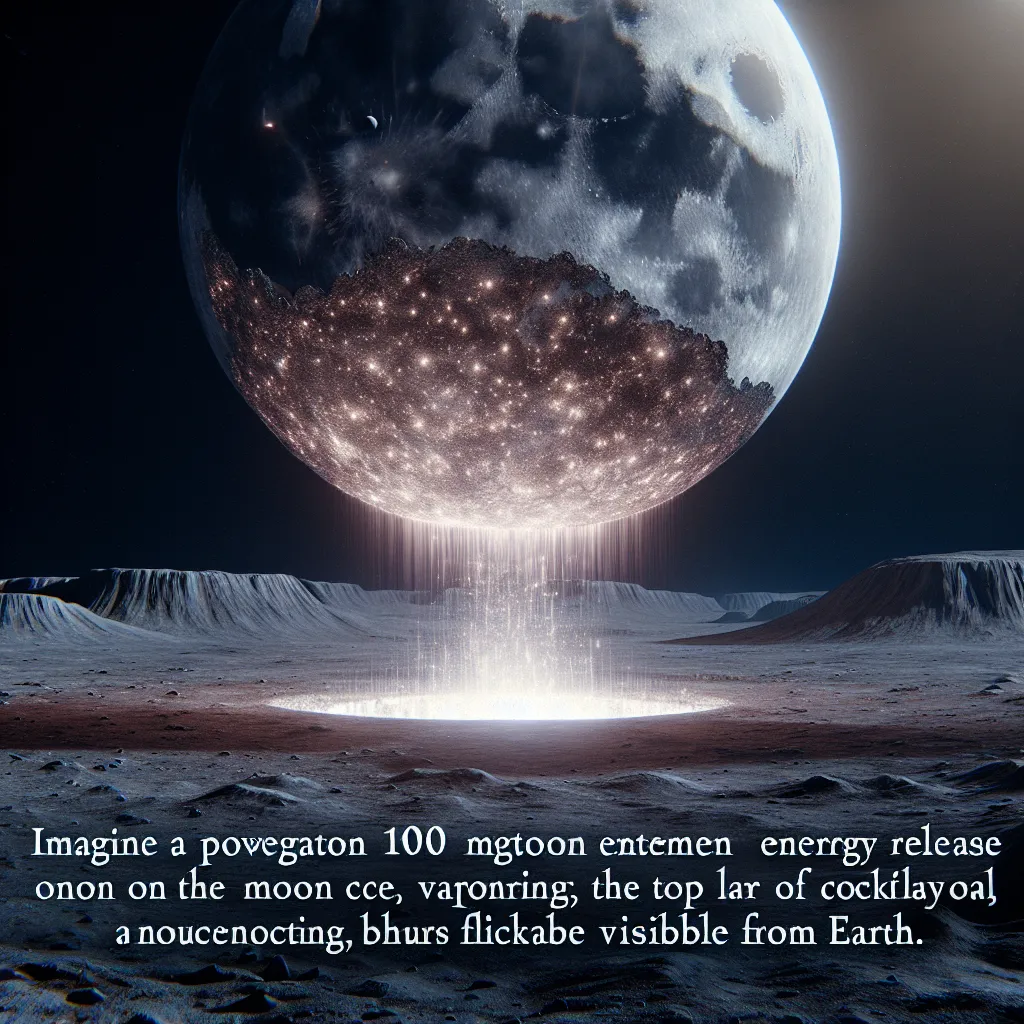
Imagine if we decided to detonate a massive nuclear bomb on the moon. What would happen? Would it knock the moon out of its orbit, sending it crashing towards Earth and causing global chaos? Or could it simply destroy the moon, resulting in a deadly meteor shower raining down upon us? During the Cold War, the moon was a hot target for both space exploration and potential military bases. The US Air Force even conducted serious studies on the impact of a nuclear detonation on the moon’s surface.
Let’s make this more interesting and visualize a 100 Megaton thermonuclear warhead—twice as powerful as any ever detonated on Earth. Imagine placing a few astronauts around the moon to observe. When we push the button, the internal mechanisms of the bomb go to work. Shockwaves trigger a nuclear fission chain reaction, making the bomb one of the hottest places in the universe momentarily.
Without an atmosphere, the fireball releases a flash of X-rays and thermal photons that spread out in all directions. On Earth, this would incinerate everything within a 50 km radius, but the moon’s lack of air and flammable materials means no burning. The top layer of the silicate rock and metal surface vaporizes, and unlucky dust inside the fireball melts into glass.
Astronauts within 50 km would be toast, but the major difference between the explosion on the moon and Earth is the absence of shock waves. On Earth, the atmosphere compresses around the explosion, creating destructive shock waves. On the moon, without an atmosphere, the fireball just expands silently. Without atmospheric pressure, there’s no booming sound, making the fireball’s growth eerily quiet but deadly due to ionizing radiation.
The explosion also causes moonquake comparable to a 7.0 on the Richter scale, shaking the ground violently. It’s as if an asteroid the size of the Great Pyramid struck. A massive crater would form at the explosion site, ejecting enormous amounts of dust and rock into the sky. Without air resistance, some of this debris would never return, becoming tiny meteoroids that might eventually reach Earth. These miniature projectiles would pose severe threats to astronauts and satellites.
Unlike the Earth, where a nuclear fireball rises into a mushroom cloud, the moon’s atmosphere-less environment prevents this. Instead, the plasma bubble expands and cools, fading away within seconds. From Earth, you might see a brief star-like flicker. Any debris from the explosion, illuminated by the Sun, would create an eerie show for anyone watching from a distance.
The moon’s orbit wouldn’t change from this explosion. Our massive nuke wouldn’t make a dent in the moon’s cosmic path. The radioactive debris left would settle back onto the moon, contaminating it for anyone trying to visit or build there. However, radiation levels would drop to more natural levels within a year.
So, despite a massive explosion, the moon would barely flinch. Using the moon as a nuclear playground is not a great idea; it ruins the fun for future lunarscape explorers and builders. Maybe it’s best to leave the moon’s cold, silent surface undisturbed and dream up other, less destructive experiments.