Which Cosmic Avatar Will Shape Our Universe's Fate?
A Cosmic Tug-of-War: The Universe's Fate Hinges on Dark Energy and Matter
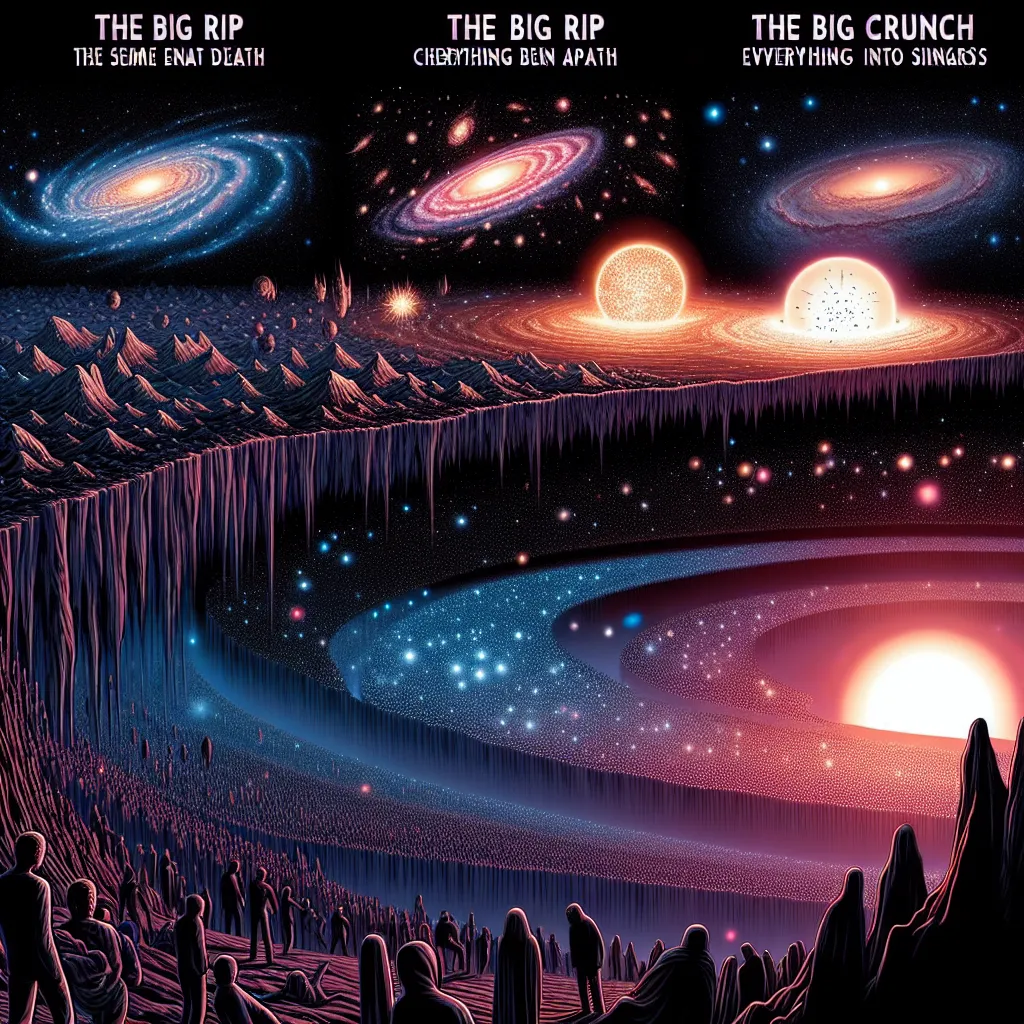
One day, the universe will meet its end. The big question is, how will it happen? It looks like this cosmic drama will be decided by a clash between two cosmic forces.
The universe was born 14 billion years ago with the Big Bang and has been expanding ever since. As it expands, new empty space is being created between galaxies. This brings us to our two cosmic contenders: matter and dark energy.
Matter, which includes galaxies, gas, and dark matter, has one simple goal: to stick together. Matter is pulled together by gravity, which also slows the expansion of the universe.
On the other hand, we have empty space filled with dark energy. This mysterious force acts like anti-gravity, pushing things apart and accelerating the expansion of the universe.
So, who will win this cosmic battle? Let’s take a look at a few scenarios.
Constant Dark Energy – Heat Death If dark energy stays constant, it will ultimately win. As the universe expands, new empty space—and thus more dark energy—is created, pushing everything apart faster and faster. Over time, galaxies will merge into supergalaxies, and eventually, we won’t see other galaxies at all.
In about 100 trillion years, all stars will die out, leaving a dark universe filled with cold, dead stars. Over incredibly long timescales, even these will dissolve into nothingness, leaving a universe with just a few lonely particles drifting through endless space. This bleak future is known as Heat Death, or the Big Freeze.
Increasing Dark Energy – Big Rip But what if dark energy gets stronger over time? In this case, dark energy doesn’t just win; it obliterates everything. Galaxies will drift apart, then stars within galaxies, then planets from stars, and finally atoms themselves will be torn apart. This scenario, called the Big Rip, ends with the very fabric of space and time being ripped to shreds.
Decreasing Dark Energy – Big Crunch On the flip side, if dark energy weakens, gravity will take over, pulling the universe back into itself. Galaxies and stars will collide and merge as space contracts, heating up tremendously. Eventually, the universe could collapse into a singularity or bounce back and begin expanding again, leading to a new Big Bang. This is the Big Crunch scenario.
So What Will Happen? Most scientists believe that dark energy will remain constant, making Heat Death the most likely outcome. While this might seem like a sad end, it gives the universe a long time to exist, allowing life to explore and thrive for trillions of years. The future is uncertain, but for now, we have an amazing universe to enjoy and explore.