5 Things About the Sun That Still Baffle the World's Best Scientists
Discover 5 unsolved mysteries about the Sun — from its scorching corona to unpredictable solar flares. Explore the science and read on to find out what we still don't know.
The Sun is about 93 million miles away. You can’t touch it, you can’t fly to it, and staring at it directly will ruin your eyes in seconds. Yet despite all the telescopes, satellites, and decades of scientific work pointed at it, the Sun still keeps secrets. Big ones. The kind that make physicists scratch their heads and rethink entire theories.
Here is the strange part — we know more about stars thousands of light-years away than we do about the one sitting right outside our own solar system. So let’s talk about five things about the Sun that nobody has fully figured out yet.
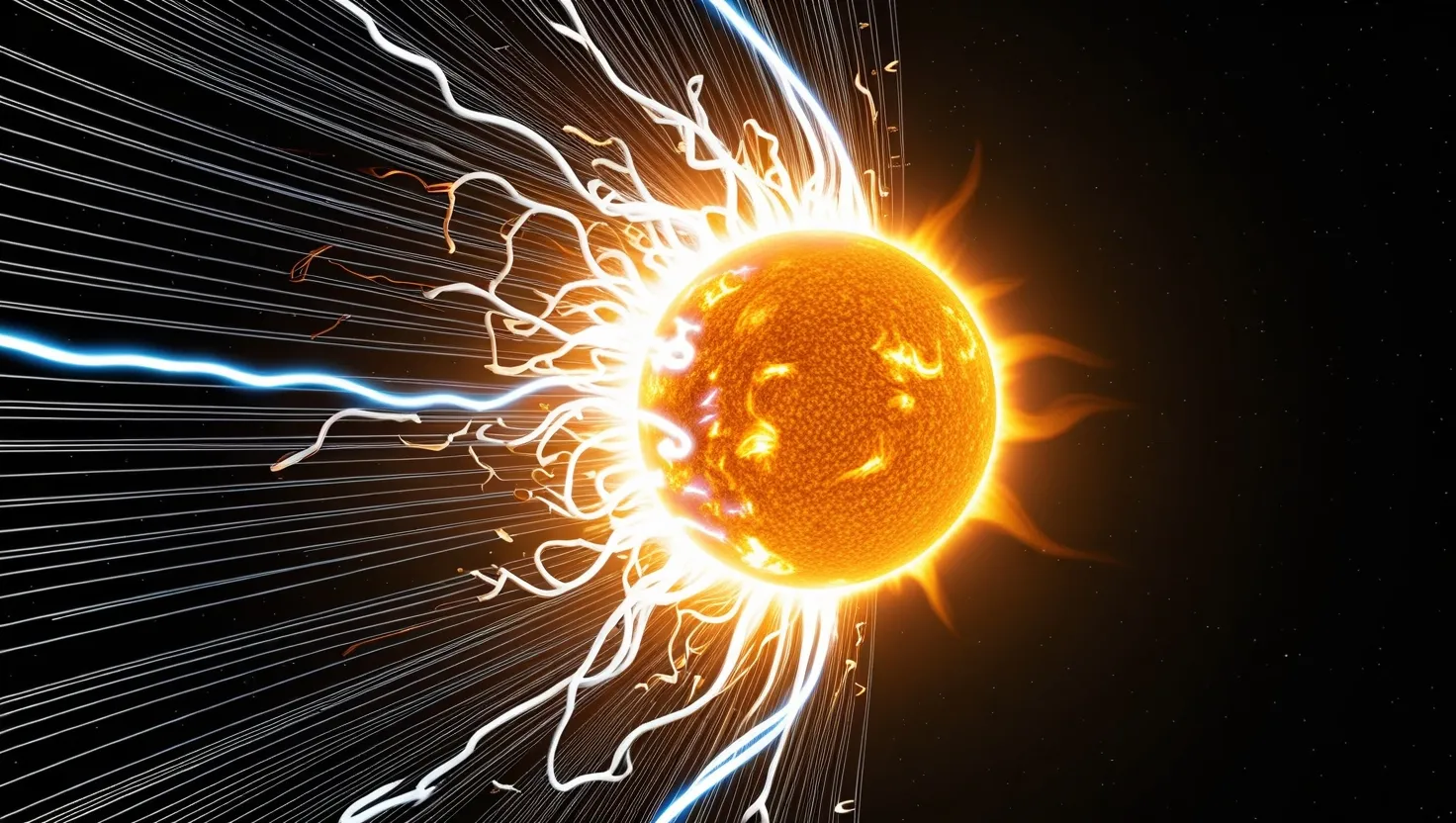
Start with the most obvious question. If you put your hand close to a fire, the closer you get, the hotter it feels. Move away, and it cools down. Simple, right? That’s how heat works. So why is the outer atmosphere of the Sun — called the corona — millions of degrees hotter than its visible surface?
The surface of the Sun sits at roughly 5,500 degrees Celsius. Move a few hundred kilometers outward into the corona, and the temperature explodes to anywhere between one and three million degrees Celsius. Sometimes even higher. You are moving away from the heat source and getting dramatically hotter. This should not happen. It flatly contradicts the basic rules of thermodynamics.
“The Sun, with all those planets revolving around it and dependent on it, can still ripen a bunch of grapes as if it had nothing else in the universe to do.” — Galileo Galilei
Scientists have spent decades arguing about what causes this. Some believe tiny explosions called nanoflares — too small to detect individually but happening constantly across the Sun’s surface — dump enough energy into the corona to keep it blazing hot. Others point to magnetic waves that travel up from the surface and release energy as they break apart in the corona. Both ideas have evidence. Neither one completely solves the problem on its own. The coronal heating problem has been sitting on the table since the 1940s and we still don’t have a clean answer.
Think about what that means. Our star, the one that keeps every living thing on this planet alive, has an atmospheric behavior we genuinely cannot explain. That’s not a small gap in knowledge. That’s a giant hole.
Now here’s something that sounds almost too neat to be real. Every eleven years, the Sun’s magnetic field flips completely. North becomes south, south becomes north. Like clockwork. We’ve tracked this cycle for centuries.
But do we know why? Not really.
We know the process involves something called the solar dynamo — the movement of electrically charged plasma deep inside the Sun that generates magnetic fields. But what actually triggers the reversal, what determines how strong each cycle will be, and what makes some cycles more intense than others — those answers are still theoretical. Models exist, but they disagree with each other on important details.
Have you ever wondered why some years produce dramatic solar storms while others are relatively quiet? That unpredictability comes from this gap in understanding. We could not have predicted that Solar Cycle 24, which began around 2008, would be one of the weakest in a century. We also couldn’t fully predict the surprising strength of the current Cycle 25.
“We are just an advanced breed of monkeys on a minor planet of a very average star. But we can understand the Universe. That makes us something very special.” — Stephen Hawking
This matters enormously in the real world. Solar cycles drive space weather. Strong solar activity can knock out power grids, fry satellite electronics, disrupt GPS systems, and interfere with radio communication. Without the ability to accurately predict cycle strength, our early warning systems are working with incomplete information.
In the 1960s, scientists built detectors underground to count something called neutrinos — tiny, nearly massless particles produced in enormous quantities by the nuclear reactions at the Sun’s core. The problem was simple and alarming: they were only detecting about one-third of the neutrinos that their models predicted should be arriving at Earth.
For decades this was called the solar neutrino problem. Either our models of the Sun’s core were completely wrong, or something was happening to the neutrinos on their way here. It turned out to be the second option. Neutrinos can change their type — or “flavor” — while traveling. The detectors could only catch one type, so they missed the others. When detectors were built that could catch all three flavors, the numbers matched up.
Problem solved, right? Not quite. For neutrinos to change flavor, they must have mass. But the Standard Model of particle physics — the rulebook that describes all known particles — originally said neutrinos have zero mass. So solving the solar neutrino problem created a new one. We had to acknowledge a gap in one of the most successful scientific frameworks ever built.
The Sun, just by producing particles, exposed a flaw in our fundamental understanding of physics. That’s an extraordinary thing to sit with.
Solar flares and coronal mass ejections are the Sun throwing a tantrum. A flare is a burst of electromagnetic radiation. A coronal mass ejection, or CME, is a massive cloud of charged particles thrown out into space at millions of miles per hour. When a big one heads toward Earth, it can cause serious damage.
What triggers these events? Magnetic reconnection — when magnetic field lines snap and rearrange, releasing enormous energy in an instant. We know this is the mechanism. What we cannot do is predict it reliably at the scale of the Sun.
“Nature is not only stranger than we suppose, but stranger than we can suppose.” — J.B.S. Haldane
Think of it like trying to predict exactly when a rubber band will snap. You can see the tension building. You know it will break eventually. But the exact moment? No. That uncertainty, scaled up to a star with a diameter of 1.4 million kilometers, is genuinely terrifying when you consider what a poorly-timed solar superstorm could do to modern infrastructure.
The 1989 Quebec blackout was caused by a solar storm. Nine million people lost power for up to nine hours. A 1859-level event — known as the Carrington Event — hitting today’s interconnected world could potentially cause trillions of dollars in damage and take months or years to fully recover from. Our warning time for a direct CME hit is somewhere between 15 minutes and a few hours. That’s not a lot.
The last mystery is the one that gets the most political noise around it, which often drowns out the actual science. The Sun’s energy output is not perfectly constant. It changes — slowly, over decades and centuries. One of the most studied examples is the Maunder Minimum, a period roughly between 1645 and 1715 when sunspot activity nearly vanished. This coincided with a period of unusually cold temperatures in Europe and North America, sometimes called the Little Ice Age.
Does this mean the Sun drives Earth’s climate in ways we haven’t fully measured? The honest answer is: partly, yes, but we don’t know exactly how much.
What makes this genuinely tricky is that the changes in solar output we can measure — called total solar irradiance — seem too small on their own to account for the temperature shifts observed during the Maunder Minimum. Something amplifies the signal. Some researchers point to changes in ultraviolet radiation affecting the stratosphere. Others point to indirect cloud-seeding effects through cosmic ray flux. None of these mechanisms are fully pinned down.
“The most beautiful thing we can experience is the mysterious. It is the source of all true art and science.” — Albert Einstein
This is a question worth caring about outside of any political context. If the Sun can significantly influence Earth’s climate on timescales of centuries, then understanding that mechanism is critical for building accurate climate models — models that inform decisions about energy, agriculture, and disaster preparedness.
What’s striking about all five of these mysteries is that they’re not obscure edge cases. The corona surrounds the entire star. The magnetic cycle governs space weather that affects satellites we use every day. Neutrinos pass through your body — literally billions per second — and we still don’t fully understand their properties. Flares can collapse power grids. And the Sun’s long-term variability shapes the climate of the only planet we live on.
The Sun is not a solved problem. It’s the closest and most powerful thing in our solar neighborhood, and it keeps reminding us how much we still have to learn. That should make you curious, not anxious. Because every one of these mysteries is a door. And behind each door is physics we haven’t written yet.