Did Buzz Aldrin and I Discover a Martian Paradise on Earth?
Stepping into Earth's Ultimate Alien Landscape: South Pole Adventures with Moonwalker Buzz Aldrin
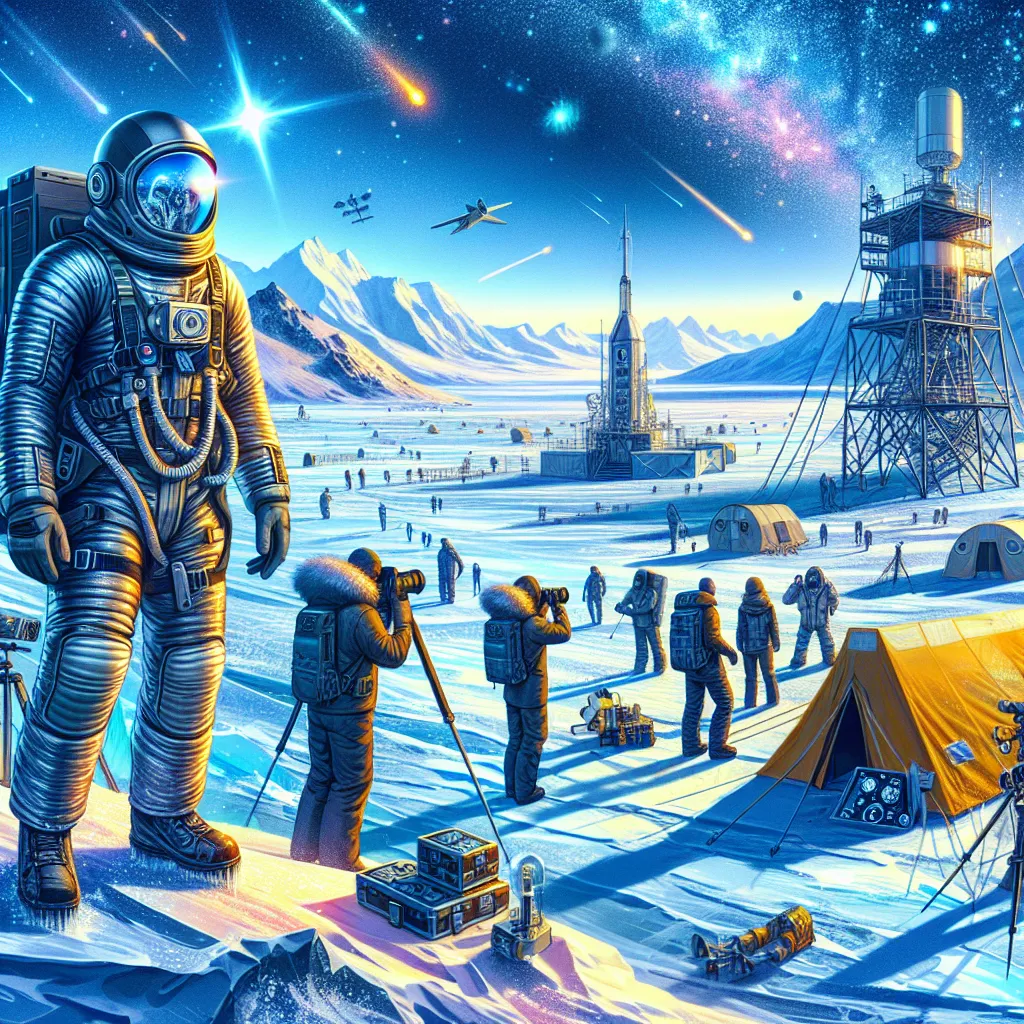
Hey everyone, I’m Nigel and welcome to my little corner of the universe, “Nigel Goes to Space!” I haven’t taken a ride beyond our atmosphere just yet, but I recently experienced Earth’s own extreme version of an extraterrestrial environment: the South Pole.
So, I found myself embarking on this frigid adventure not just for the thrill but also to understand what it’s like to survive in such harsh conditions, similar to those we would encounter on Mars. And guess who was my travel buddy? None other than Buzz Aldrin, the celebrated pilot from the Apollo 11 mission to the moon. Buzz is now passionate about sending humans to Mars.
Our journey started in the warmth of Cape Town, South Africa, where Buzz and I got acquainted atop Table Mountain. Soon after, we checked our gear and boarded a Russian Aleutian transport plane destined for Antarctica. The plane was mostly filled with scientists traveling to their respective bases.
Crossing the Antarctic Circle was surreal. We hit the land of six months of unending daylight or darkness. During our visit, daylight reigned supreme. Our first stop was a Russian airstrip called Novolazarevskaya, close to a Russian base. We were a small crew of twelve, remarkably the same number of people who have walked on the moon.
From there, we boarded a smaller, unpressurized plane flying into the heart of Antarctica. The landscape below was an endless sea of ice, over a thousand meters thick, glittering as far as the eye could see. We made a refueling stop at a depot lined with rows of red fuel barrels and then continued further south.
Finally, we landed at the bottom of the world. Here, two distinctive alien-like structures greeted us. One was the “IceCube” experiment, searching for cosmic particles, and the other was a space telescope probing the remnants of the Big Bang. Both placed here for the ultimate cosmic revelations.
Stepping out of the plane, we were standing on the thick, shifting ice cap, an otherworldly feeling that I can’t quite describe. The South Pole, marked by a ceremonial pole surrounded by flags, shifts over time due to the moving ice. Determined, I found myself standing at this exact point, where all longitudinal lines converge.
Buzz Aldrin has achieved so much—Moon landings, North Pole visits, deep-sea dives to Titanic—but being at the South Pole was another feather in his illustrious cap. The American-run Amundsen-Scott Base welcomed us warmly. As a national hero, Buzz was inundated with questions about space and Mars.
One unique souvenir we could collect was a specialized stamp in our passports, a quirky yet personal keepsake from this icy realm. However, any trip here is demanding. Our journey required a night’s stop in -24 degrees at the refueling depot, sleeping inside tents. Buzz had a brief health check and was advised to return to sea level, leaving us to complete our South Pole adventure before returning to our coastal base.
The Antarctic coast offered more Mars-like landscapes with its reddish-brown rocks. Unlike Earth’s fertile land, here, turning over a rock rarely reveals life. Throughout my time there, I found just one tiny patch of greenery. This lifelessness is why finding life on Mars would be immensely challenging.
We indulged in some thrilling ice-climbing and explored stunning blue ice caves, all while cold and peril fighting for attention. We even visited a Russian base for atmospheric research, witnessing firsthand the effects of global warming.
Accommodation was in bubble-shaped pods set in a Martian-like expanse, pressurized to mimic living on Mars. Buzz was impressed by how well everything worked together, calling it the template for future Martian colonies.
Leaving Antarctica, I couldn’t shake off the awe of this adventure. Back to Cape Town, it was one final thrilling chapter transitioning from this alien world back to civilization.
This was genuinely the most jaw-dropping experience of my life, and it might hold that title until, fingers crossed, I venture into space for real. In the meantime, follow my journey by subscribing to “Nigel Goes to Space.” Got questions about space or the universe? Send them my way!