Quantum Biology: How Living Cells May Be Bending the Rules of Reality
Discover how quantum biology is rewriting our understanding of life. From bird navigation to human consciousness, explore the quantum tricks nature mastered. Read more.
Life is weirder than you think. Not weird in a “wow, octopuses have three hearts” kind of way. Weird in a “the rules of reality might be bending inside every living cell right now” kind of way. Quantum biology sits at that uncomfortable crossroads where the tiny, strange world of particles meets the warm, messy world of living things. And what it is finding should make your jaw drop.
Most of us learned in school that quantum mechanics is the physics of the very small — atoms, electrons, subatomic particles. It governs things like why atoms glow certain colors or how semiconductors work. The assumption was always that once you zoom out to the scale of cells, molecules, proteins, and living creatures, those quantum rules get washed away by heat, noise, and biological chaos. Life, we thought, was too warm and wet for quantum effects to survive.
That assumption is crumbling.
“The most beautiful thing we can experience is the mysterious. It is the source of all true art and science.” — Albert Einstein
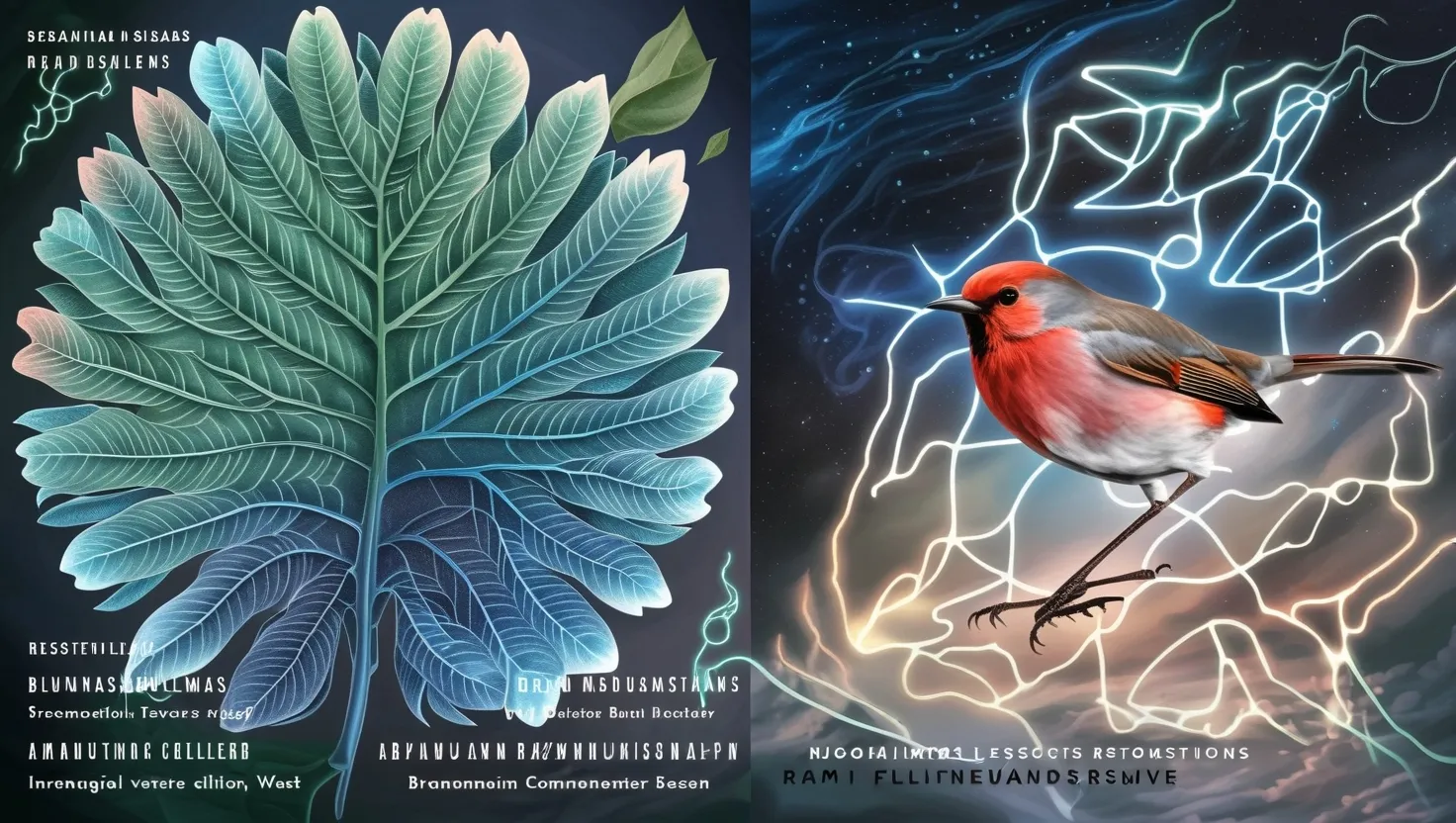
Think about photosynthesis for a moment. A plant absorbs a photon of light. That energy then needs to travel from the point of absorption to a reaction center deep inside the cell where it actually gets converted into chemical energy. The distance is tiny by human standards but enormous at the molecular level. And somehow, plants do this with almost perfect efficiency — almost no energy is lost along the way.
Here is the strange part. When scientists looked closely at how that energy travels, they found something they did not expect. The energy does not simply hop from one molecule to the next like a ball rolling down a staircase. Instead, it appears to exist in multiple pathways at once, testing all possible routes simultaneously, and then collapsing onto the fastest one. This is quantum coherence — a phenomenon where a particle or energy exists in a superposition of states until it is observed or measured.
Think of it like this. Imagine you are in a maze. Normally, you would try one path, hit a dead end, come back, try another, and so on. Quantum coherence is like being able to try every path at the same time and instantly knowing which one leads out. Plants may have been doing this for hundreds of millions of years.
Does it strike you as odd that nature solved quantum computing before humans even had the concept?
Now let us talk about birds. Specifically, migratory birds like the European robin. These creatures fly thousands of miles and land in the exact same spot year after year. For a long time, scientists assumed they used the Earth’s magnetic field like a compass. Simple enough. But the mechanism behind it turned out to be anything but simple.
Inside the robin’s eye, there is a protein called cryptochrome. When light hits this protein, it creates a pair of electrons — called a radical pair — whose spins are quantum mechanically entangled. The spin state of these electrons is sensitive to the Earth’s magnetic field. Depending on which direction the bird is facing relative to the magnetic field, the chemistry of these electron pairs changes. The bird’s brain reads those chemical signals and gets directional information.
This is not metaphor. This is quantum entanglement happening inside a living eye, in real time, in a warm biological environment.
“In nature’s economy, the currency is not money, it is life.” — Vandana Shiva
What makes this even stranger is that scientists tried to disrupt the robin’s navigation using very weak radio waves — waves too weak to affect classical chemistry but strong enough to interfere with quantum spin states. The birds got confused. They lost their sense of direction. That is compelling evidence that the navigation system is genuinely quantum mechanical.
Your nose might be the next surprise. The traditional explanation for how smell works is called the “lock and key” model. A molecule floats up to a smell receptor, fits into it like a key into a lock, and triggers a signal. The shape of the molecule determines what you smell. Clean, simple, mechanical.
Except there is a problem. Some molecules have nearly identical shapes but smell completely different. And some molecules with very different shapes smell almost the same. The lock and key model cannot fully explain this.
A competing theory — one that has been gaining traction — suggests that the nose detects the vibrations of molecules rather than just their shape. Molecules vibrate at specific frequencies, and those frequencies are unique, like molecular fingerprints. The proposed mechanism is electron tunneling, where an electron jumps across a gap in a receptor only when the vibration frequency of the molecule matches the receptor’s requirements.
Can you imagine? You smell a rose, and somewhere in your nose, electrons are tunneling through quantum barriers, matching vibrational frequencies to decode the scent. Your brain then says: “rose.” Billions of years of evolution built a quantum spectrometer and put it in your face.
“What we observe is not nature itself, but nature exposed to our method of questioning.” — Werner Heisenberg
Enzymes are the worker molecules of biology. They speed up chemical reactions inside your body — reactions that without them would take thousands of years to complete on their own. They do this extraordinarily well. Too well, in fact, for classical chemistry to fully explain.
The extra speed comes, at least partially, from quantum tunneling. In a classical world, for a chemical reaction to happen, the molecules involved need enough energy to climb over an energy barrier — picture a ball rolling over a hill. But in quantum mechanics, particles can pass through barriers rather than over them. They tunnel.
Enzymes appear to be shaped in a way that positions reacting atoms so close together that tunneling becomes probable. The enzyme does not just lower the hill. It lets the ball pass through the hill entirely. This happens inside your body every second. Hydrogen atoms tunnel through energy barriers in enzyme-driven reactions that your digestion, your DNA replication, and your metabolism depend on.
Here is something worth sitting with: your body may be running on quantum tricks so efficient that we cannot yet replicate them in the most sophisticated laboratories on Earth.
Now we arrive at the most controversial question in all of quantum biology, maybe in all of science. What if consciousness itself is quantum?
In the 1990s, physicist Roger Penrose and anesthesiologist Stuart Hameroff proposed a theory called Orchestrated Objective Reduction, or Orch-OR. The idea is that consciousness arises from quantum computations happening inside structures called microtubules — tiny protein scaffolds inside neurons. According to this theory, the brain does not compute thoughts the way a classical computer does. Instead, quantum superpositions form and collapse inside microtubules, and that process is the physical basis of conscious experience.
Most neuroscientists are skeptical. The brain is warm and wet, and quantum states are famously fragile — they collapse almost instantly when they interact with their environment. Maintaining quantum coherence in the brain seems nearly impossible.
But “nearly impossible” is not the same as impossible. And we have already seen that warm, wet, noisy biological systems can sustain quantum effects in photosynthesis and navigation. So who is to say the brain is different?
“Consciousness is a much smaller part of our mental life than we are conscious of.” — William James
Ask yourself this: does the current neuroscience fully explain what it feels like to be you? Does it explain why there is something it is like to see red, or feel heartbreak, or notice the silence before a storm? Most honest scientists will tell you no. Consciousness remains the hardest problem in science. Quantum biology may not solve it, but it at least suggests that the answer might be stranger and deeper than conventional biology assumed.
Quantum biology is not fringe science anymore. It is being studied in serious labs across the world, published in top-tier scientific journals, and funded by major research institutions. The field is young, the evidence is still being gathered, and many questions remain open. But the direction of travel is clear.
Life did not evolve despite quantum mechanics. Life may have evolved to use it.
Every plant catching sunlight, every bird finding its way home, every breath you take, every thought you have — all of it might be threaded through with quantum effects that we are only beginning to see. The machinery of biology runs on a deeper, stranger physics than any of us imagined. And that is not frightening. That is extraordinary.