The Mathematical Constants That Secretly Control Every Living Thing and Cosmic Phenomenon
Discover how 7 mathematical constants secretly shape everything from flower spirals to galaxies. Explore nature's hidden code where golden ratio, pi, and Fibonacci numbers rule reality itself.
There’s a secret world humming behind every living thing and every cosmic spectacle—a world where mathematics whispers the instructions for form and function, growth and decay, creation and collapse. As I look around, it’s impossible to miss how certain numbers and ratios quietly thread through patterns I see in flowers, the swirl of galaxies, river bends, and even the way trees branch or blood flows. Why do these mathematical constants keep cropping up in so many different places? Is nature really built on numbers, or are we just seeing what we want to see?
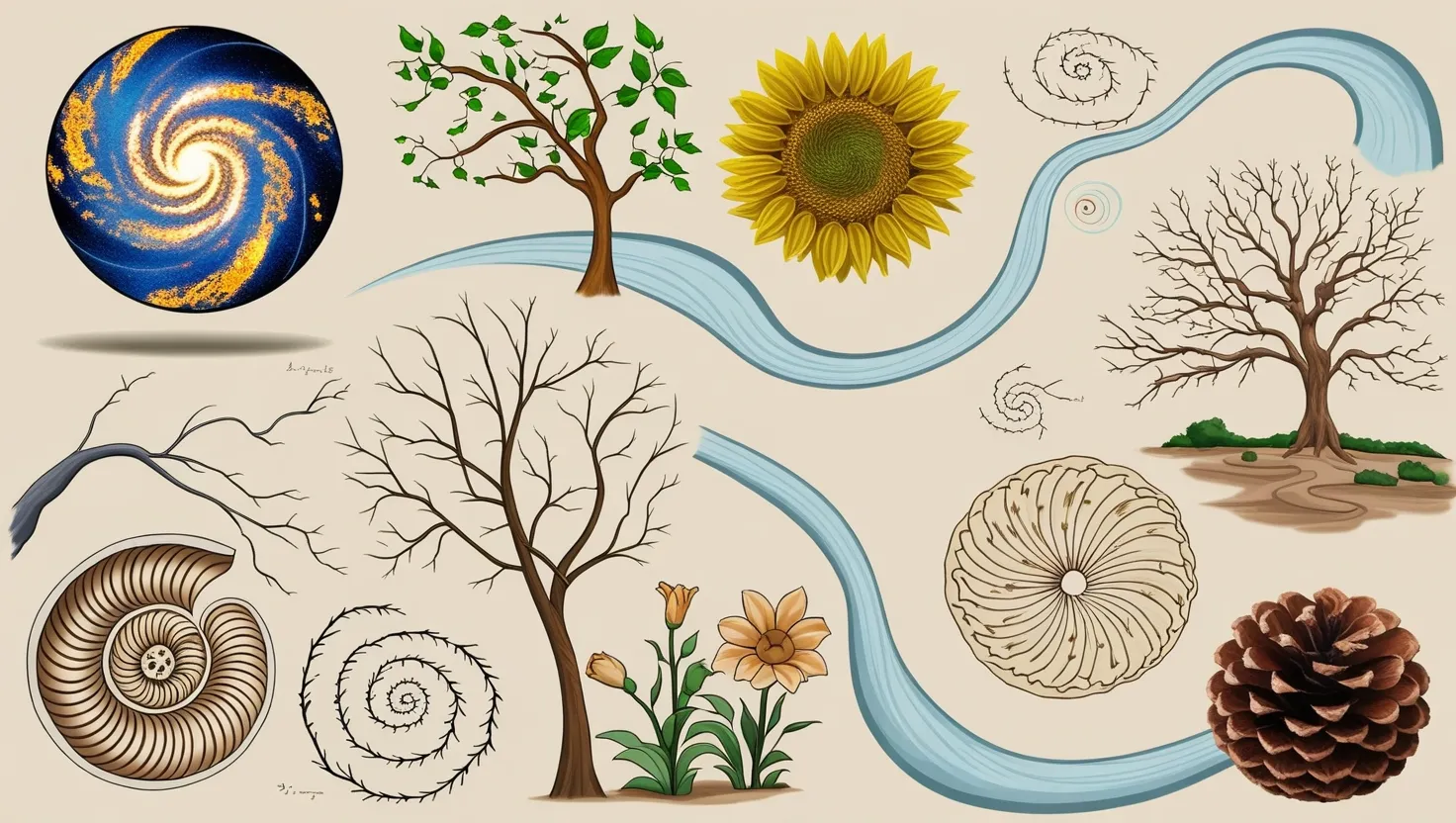
Let’s start with the golden ratio, φ. I’ve seen it described as nature’s favorite number, turning up in the spirals of sunflowers, the proportions of a shell, and even the way leaves align along a stem. But it’s so much more than a simple “pretty” pattern. The golden ratio represents an optimal packing strategy—nature’s way of making sure each leaf gets maximum sunlight, or that seeds are distributed most efficiently on a flower’s head. Even on the scale of galaxies, their spirals often echo the proportions of φ, a hint that geometry isn’t just a mathematical abstraction but perhaps a guiding principle behind cosmic structure. Sometimes I wonder: if φ disappeared, would sunflowers and spiral galaxies look completely different?
“Mathematics is the language with which God has written the universe.” – Galileo Galilei
Euler’s number, e, is another constant that shapes the world, but in subtler ways. It’s the backbone of exponential growth and decay. When I watch a population of rabbits grow or look at the curve of a radioactive isotope decaying, e’s fingerprint is there. Even the growth of your savings in a bank account follows e’s rules, through compound interest. Exponential change is hard for the human mind to grasp, but nature happily evolves by its logic. What’s unusual is that systems as different as bacterial colonies and economic wealth follow the same mathematical recipe. Does e represent a universal tendency toward acceleration—toward sudden, runaway change?
“Nature does not make long leaps.” – Gottfried Wilhelm Leibniz
Then there’s π, a number taught in classrooms as the ratio of a circle’s circumference to its diameter. But π isn’t just for circles. It’s everywhere: describing the winding of rivers, hiding in the equations governing heat flow, and even helping define the probability that two random numbers have no common divisors. In quantum mechanics, π shows up in wave functions, tying together the rules of chance with the fabric of the universe. When I see a meandering river, I realize its curve isn’t just shaped by water and earth but by a mathematical principle as old as geometry itself. Why is circular mathematics hidden in the randomness of river paths and quantum waves?
“If people do not believe that mathematics is simple, it is only because they do not realize how complicated life is.” – John von Neumann
Let’s zoom into the atom. The fine structure constant, α, is a curious one. It’s a number with no physical units, a pure ratio that controls the strength of electromagnetic interactions. If α were even slightly different, atoms wouldn’t hold together, chemistry would break down, and life—at least as we know it—would be impossible. To me, α feels like a cosmic dial: turn it up or down, and reality changes its rules. No one really knows why it has the value it does. Is it a happy accident, or is there a deeper reason buried in the structure of the universe?
Now, Fibonacci numbers are the ones most people recognize from pinecones, pineapples, and the way seeds spiral in a sunflower. Each number is the sum of the two before it—a simple rule, but one that leads to intricate patterns. When I open a pinecone or examine the branches of a tree, Fibonacci numbers guide their arrangement, optimizing for sunlight, space, or strength. Blood vessels, too, branch in patterns reminiscent of this sequence, maximizing distribution with minimal effort. It fascinates me that such a simple rule can produce so much complexity and efficiency. Why does nature seem to prefer additive growth—a stepwise building—over more complicated schemes?
“Pure mathematics is, in its way, the poetry of logical ideas.” – Albert Einstein
Planck’s constant, h, lives in the world of the very small. It sets the scale for quantum jumps—how energy, matter, and information operate in packets, not in a smooth flow. Every time we measure the energy of a photon or peer into the black-body spectrum of stars, h is there, setting the granularity of reality. I think of h as the universe’s minimal currency, making sure nothing can be infinitely divided. If h were zero, quantum mechanics would vanish, and so would the stars, chemistry, and consciousness. Isn’t it astonishing that a number so small can define the limits of what’s possible, and even of what we can know?
“What we observe is not nature itself, but nature exposed to our method of questioning.” – Werner Heisenberg
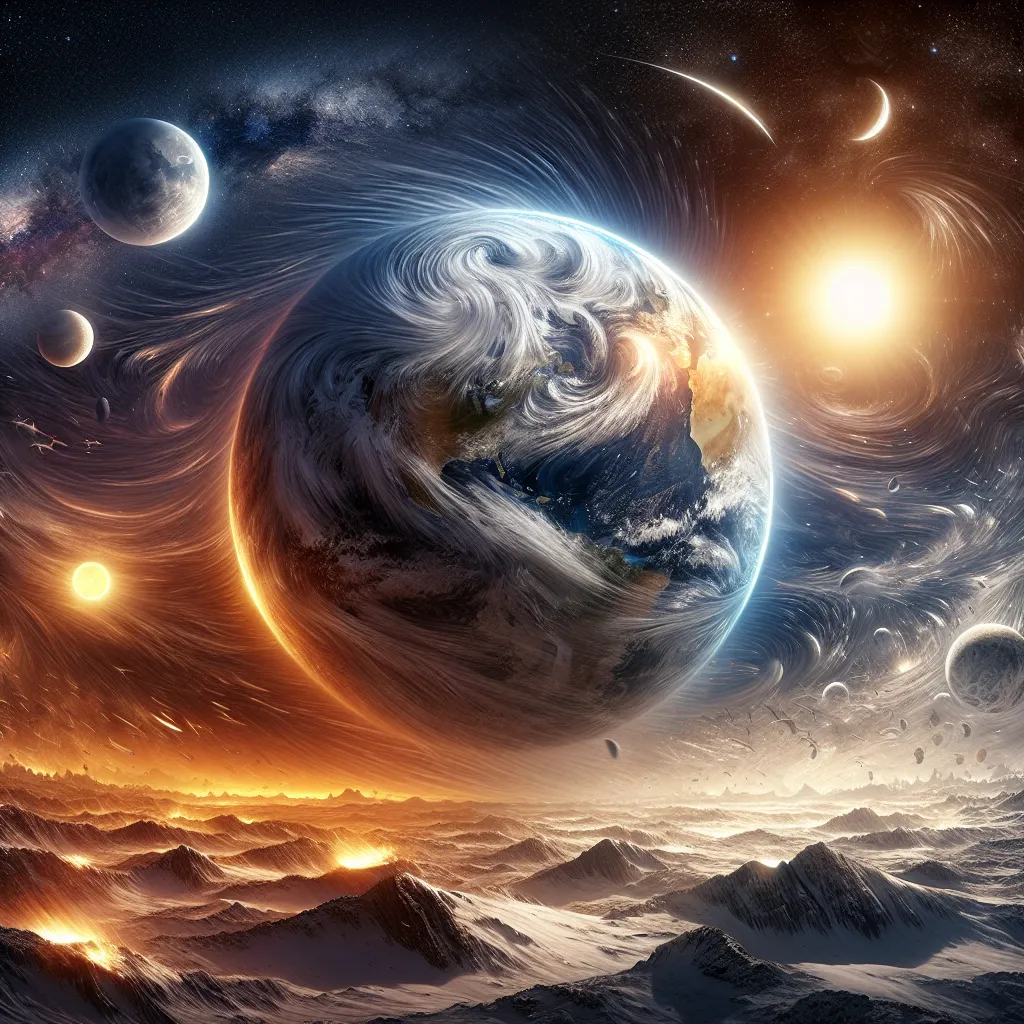
Finally, the cosmological constant, Λ, sits at the largest scale imaginable. It shapes the expansion of the universe, countering gravity and fueling the slow stretching of space itself. What’s bizarre is how tiny Λ is—so close to zero that for most of human history, we didn’t even know it existed. Yet without Λ, galaxies wouldn’t form; with a larger Λ, matter would disperse before stars could ignite. It’s as if nature is balancing on a razor-edge, using Λ to fine-tune the possibility of structure and life. The more I ponder this constant, the more I wonder: was Λ inevitable, or is our universe just one version in a cosmic lottery?
“Equipped with his five senses, man explores the universe around him and calls the adventure Science.” – Edwin Hubble
What ties these seven constants together is not just that they appear in equations. They shape the fabric of reality itself, echoing from the quantum scale to the sweep of galaxies. I find that each number is both a fingerprint and a blueprint—a clue to how the universe builds order out of chaos, and sometimes, how it preserves randomness within order.
As I trace the patterns of mathematics in the world, I ask—how much is coincidence and how much is inevitability? If we lived in another universe, would these constants still rule? Or do they reflect something deeper about logic and possibility itself?
It surprises me how the same constants appear in fields so far apart. Patterns that guide the form of shells also govern the brightness of stars. Numbers born in ancient geometry shape not only flowers but also the very atoms that make them. At times, it feels as if we’re only scratching the surface of a much grander architecture—one where mathematics isn’t merely a human invention but an intrinsic part of reality.
“When you can measure what you are speaking about, and express it in numbers, you know something about it.” – Lord Kelvin
Next time you see a pinecone, the arc of a river, or the spiral of a galaxy, remember: behind their elegance is a code—ancient, universal, and profoundly mathematical. Maybe the world isn’t written in plain language but in the subtle poetry of numbers, patterns, and constants. And every time I discover a new connection, I’m left with fresh questions: What else are we missing? How many more secrets wait, hidden in the numbers that shape every leaf, every wave, every star?