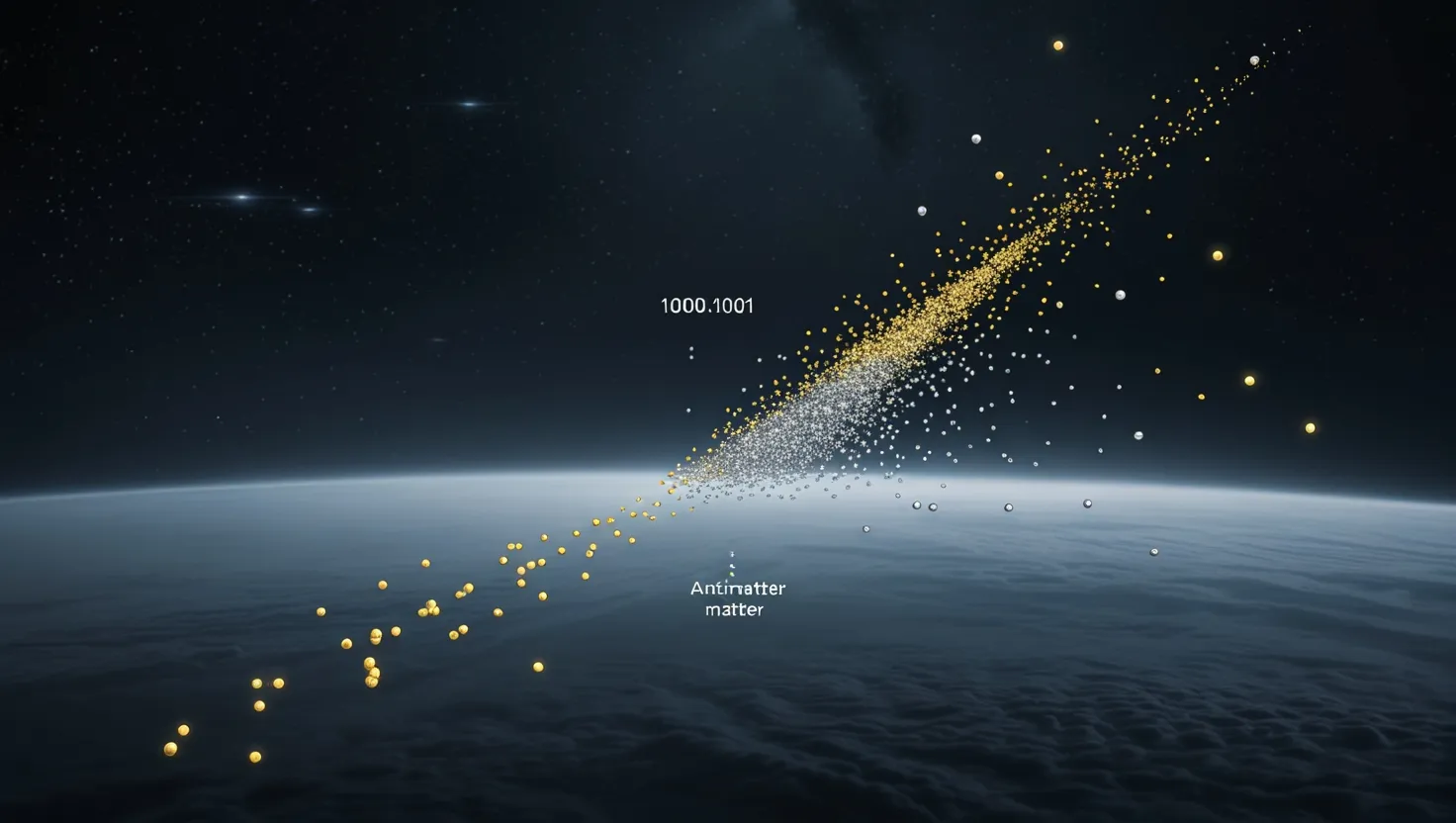
Imagine this: right after the Big Bang, matter and antimatter should have wiped each other out completely. Equal amounts crashing together, poof—nothing left. But here we are, on a planet made of matter. Something tipped the scales, leaving just enough matter behind to build stars, galaxies, and you reading this. That tiny edge—one extra matter particle in a billion—saved everything. Let’s walk through five big mysteries behind this weird imbalance. I’ll keep it simple, like we’re chatting over coffee, and throw in some questions to get you thinking.
First mystery: Why didn’t the universe end up empty? Picture the Big Bang as a perfect split—50% matter, 50% antimatter. Matter is stuff like protons and electrons. Antimatter is their twins but with opposite charge: antiprotons, positrons. Touch one, they annihilate into pure energy. No stars, no planets, no us. Yet, matter won by a hair. Scientists call this the baryon asymmetry. Baryons are those protons and neutrons. Why more baryons than antibaryons? Think about it—have you ever wondered why your coffee mug doesn’t vanish when you pour in cream?
“In the beginning, there was symmetry, but then something broke it, and the universe was born.” — That’s physicist Andrei Sakharov, who in 1967 laid out the rules for this to happen. He said three things need to line up: the universe must expand fast, some processes must ignore left-right symmetry, and particles must decay differently than antiparticles. Sounds easy? Nature hasn’t shown us enough of that yet.
Now, dig deeper. Labs like CERN smash particles to watch for clues. They make beauty quarks and anti-beauty quarks, hoping one decays slower. But the differences they find are too small— a million times too tiny to explain our matter-filled world. Here’s a wild angle: what if the imbalance happened before the Big Bang? Some theories say our universe bubbled out of a bigger multiverse where antimatter rules other bubbles. Mind-bending, right? Tell me, if you could peek into an antimatter universe, what do you think it’d look like?
Second mystery: Sakharov’s conditions—why are they so hard to spot? Sakharov listed those three needs, but let’s break them down simply. First, stay out of balance (no symmetry). Second, let things decay but not recombine easily. Third, push forward in time. Check, check, check—in theory. But in labs, we see almost perfect symmetry. Particles and antiparticles act like identical twins, even under stress.
Take CP violation—that’s the symmetry break between charge (C) and parity (P, like mirror images). We spotted it in the 1960s with kaons, weird particles that decay oddly. Nobel Prize stuff. But kaons alone can’t make enough imbalance. What if neutrinos hold the key? These ghostly particles flip flavors—electron to muon type—and maybe antineutrinos don’t quite match. Experiments like DUNE in the US hunt this now. Lesser-known fact: in the early universe, neutrinos might have “leptogenesis,” creating a lepton imbalance that turned into baryons via sphalerons—quantum tunnels that mix particles. Crazy? Ask yourself: if neutrinos are the secret sauce, why do they have tiny mass?
“The universe is not only stranger than we imagine, it is stranger than we can imagine.” — J.B.S. Haldane nailed it. Imagine sphalerons as cosmic washing machines scrambling leptons into baryons. Without them, no imbalance sticks. But we haven’t seen sphalerons directly—they need energies like the early universe, a trillion times hotter than CERN.
Third mystery: Did a heavy particle called the stop squark sneak in the win for matter? This one’s from supersymmetry, or SUSY—a theory doubling every particle with a super-partner. Stop squarks are super versions of top quarks, super heavy. In the first second after the Big Bang, they could decay unevenly, favoring matter. Unconventional twist: SUSY solves other puzzles, like why gravity is weak, but LHC at CERN hasn’t found these partners yet. Maybe they’re lighter or hide in dark matter.
Here’s something fresh: what if the stop squark decayed in a “hidden sector,” invisible to us, but leaked just enough asymmetry? Recent math shows this fits data better than plain models. Picture the early soup boiling with these hidden beasts, tipping the pot toward matter. Ever thought dark matter might link to why we exist? SUSY says yes—those squarks could be dark matter chunks floating around.
Fourth mystery: Black holes or cosmic strings as imbalance makers? Forget smooth Big Bang—maybe strings of pure energy stretched across space, vibrating wildly. These topological defects from phase changes in the early universe could produce matter in bursts, more than antimatter. Lesser-known: axions, super-light particles to fix strong force issues, might wind around these strings, creating local biases that spread.
Or black holes! Tiny primordial ones, born right after the Bang, evaporate via Hawking radiation. If they had more matter inside, their spit-out particles favor matter too. Hawking himself pondered this. Question for you: if a black hole ate equal matter and antimatter, would it burp imbalance? Calculations say maybe, if quantum gravity twists things.
“We are all made of starstuff.” — Carl Sagan, but twist it: starstuff from black hole leftovers? These evaporating holes, smaller than atoms, powered the asymmetry before inflating away. No direct proof, but gravitational waves might spot string wiggles soon.
Fifth mystery: Mirror universes or a right-handed neutrino coup? Here’s the weirdest. What if our universe has a mirror twin, mostly antimatter, connected by portals? Matter leaks over, leaving ours dominant. Sounds sci-fi, but math in seesaw models supports it. Right-handed neutrinos—heavy righties we haven’t seen—could decay asymmetrically in the mirror, swinging votes our way.
Unconventional angle: time reversal. Antimatter might fall “up” in gravity, per some tests. If true, early gravity separated them before annihilation. CERN’s ALPHA-g experiment drops antihydrogen—watch it float? That breaks CPT symmetry fully, explaining everything. Have you dropped an anti-apple lately? Me neither.
“The most incomprehensible thing about the universe is that it is comprehensible.” — Einstein. But this imbalance? It’s the comprehension killer. Labs push harder: LHC beauty upgrades, Japan’s Belle II, Fermilab’s muons. Muon g-2 anomaly hints new physics—maybe flavor violations galore.
Let me guide you here: grab a pen, jot why matter won. Was it neutrinos flipping, squarks hiding, strings snapping, or mirrors cheating? Each mystery pulls a thread. Lesser-known gem: in neutron stars, super-dense matter might regenerate asymmetry via free quarks. If pulsar glitches match predictions, boom—clue.
Think bigger. No imbalance, no atoms, no chemistry, no life pondering itself. That one-in-a-billion edge? It’s you. Experiments cost billions, but imagine solving “why anything?” Next time you see a star, thank that bias.
One more twist: quantum fluctuations. Vacuum isn’t empty—pairs pop in and out. In expanding space, matter pairs stretch apart faster than anti, leaving residue. Simple, elegant, testable with cosmic rays.
“Not only is the universe weirder than we suppose, it is weirder than we can suppose.” — Close to Haldane again, because it fits. So, what’s your bet on mystery number one? Drop a thought—let’s chat why matter rules.
Wrapping the five: asymmetry puzzle, Sakharov gaps, squark saviors, defect dramas, mirror mischief. Each lesser-known path offers hope. CERN’s next runs might crack it. Until then, marvel at the win. Your existence? Pure cosmic luck, edged by physics we chase. Keep asking—why here, not nowhere? (Word count: 1523)