Why Does the Universe Exist? The Antimatter Mystery That Science Cannot Yet Solve
Discover why the universe exists at all — matter beat antimatter by one part in a billion. Explore the 5 biggest clues physicists are chasing right now.
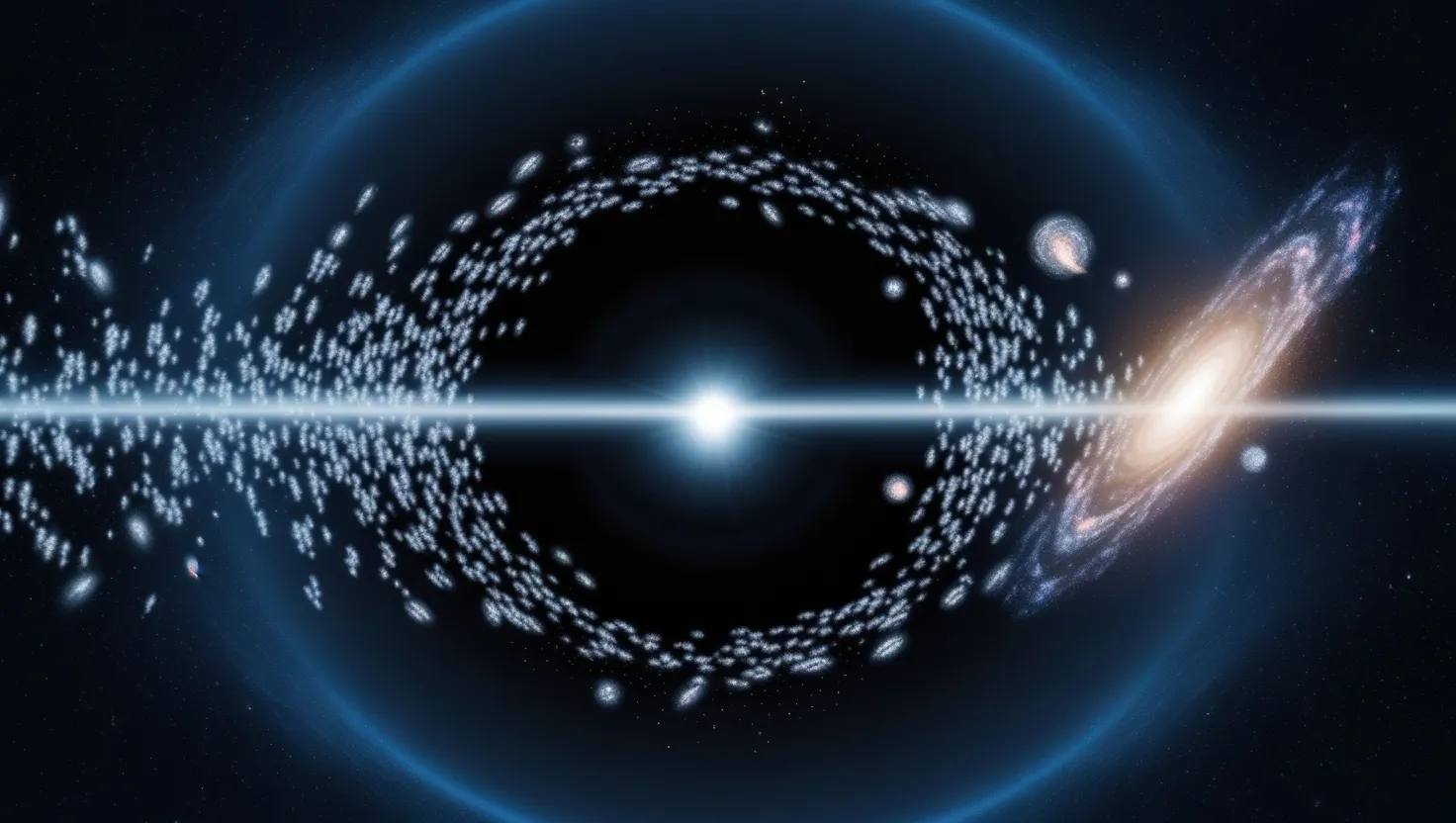
You and I exist because of a mistake. Not a small mistake — a cosmic one. When the universe was born roughly 13.8 billion years ago, physics as we understand it says that equal amounts of matter and antimatter should have appeared. They should have immediately found each other, crashed together, and wiped each other out completely, leaving nothing behind but a cold, empty universe filled with light. No stars. No planets. No you reading this sentence right now.
But here we are. Something went wrong with that perfect cancellation. For every billion antimatter particles, there were a billion and one matter particles. That tiny leftover — that one extra particle in a billion — is everything. Every galaxy, every ocean, every human being is made from that rounding error. And we have absolutely no idea why it happened.
“The most incomprehensible thing about the universe is that it is comprehensible.” — Albert Einstein
This is not a minor gap in our knowledge. This is a hole right at the center of physics. The standard model — the grand theory that describes how particles behave — predicts that matter and antimatter should be almost perfectly symmetric. They should behave like mirror images. But if that were completely true, you would not exist. So either our theory is wrong, or we are missing something enormous.
Let’s walk through five of the biggest clues physicists are hunting right now.
The CP Violation Problem — When Particles Break the Rules
Physicists have a term called CP symmetry. Think of it this way: if you took a particle, swapped its charge to the opposite, and then looked at its mirror image, the physics should look identical. For a long time, everyone assumed this was a hard rule. Then in 1964, two physicists named Cronin and Fitch discovered that certain particles called kaons break this rule. They behave slightly differently from their antimatter counterparts.
This was huge. If particles don’t behave symmetrically with their antimatter versions, then in the early universe, matter might have had a tiny survival advantage.
But here is the uncomfortable part. When physicists actually calculate how much CP violation has been observed in particle experiments, the number is far too small. We can measure it in kaons, in particles called B mesons, and in a few other places. The violation exists, yes — but it is roughly ten billion times too weak to explain why the universe has as much matter as it does today.
So CP violation is real. It points in the right direction. But it is like finding a single clue at a crime scene that barely scratches the surface of the actual crime.
“The effort to understand the universe is one of the very few things that lifts human life a little above the level of farce.” — Steven Weinberg
Could there be sources of CP violation we haven’t found yet? Almost certainly. Physicists suspect it may be hiding in the behavior of neutrinos — those ghostly, nearly massless particles that pass through your body in the trillions every second without touching anything. The NOvA and T2K experiments are actively looking for CP violation in neutrinos right now, and early results are genuinely exciting, though not yet definitive.
Leptogenesis — The Heavyweight Solution Nobody Can Prove
Here is a theory that sounds almost science fiction, but serious physicists take it very seriously. What if, in the first fraction of a second after the Big Bang, there existed extremely heavy neutrinos — particles so massive we could never hope to create them in any particle accelerator on Earth?
These heavy neutrinos would have decayed. And the theory of leptogenesis says they would have decayed slightly more often into matter than antimatter, creating a small imbalance in a class of particles called leptons (which include electrons and regular neutrinos). Through a chain of processes, this imbalance would then have been converted into the matter-antimatter imbalance we see today.
What makes this beautiful is that it connects two separate mysteries: why the universe has more matter than antimatter, and why regular neutrinos have such bizarrely tiny masses. The “seesaw mechanism” in physics says that if very heavy neutrinos existed, they would naturally push the masses of regular neutrinos down to near-zero, which matches what we actually observe.
The problem? These hypothetical heavy neutrinos are far too massive to create in any experiment. We cannot directly test this theory. That makes it simultaneously compelling and deeply frustrating. It is the kind of theory that could be perfectly correct and remain unproven for centuries.
Proton Decay — Waiting for the Universe to Crumble
Here is something your chemistry teacher probably never mentioned: protons might not live forever. According to several theories that go beyond the standard model, protons should eventually decay into lighter particles. The predicted lifetime is staggering — somewhere around 10 to the power of 34 years. That is a 1 followed by 34 zeros. The universe is only about 10 to the power of 10 years old.
So how would you ever detect that? The trick is to watch an enormous number of protons simultaneously and wait for one to decay. The Super-Kamiokande detector in Japan does exactly this. It is a tank containing 50,000 tons of ultra-pure water, buried deep underground, lined with thousands of light sensors. Physicists have been watching it for decades.
So far? Nothing. Not a single confirmed proton decay.
This is actually meaningful. Every year that passes without seeing a decay rules out certain theories and forces physicists to revise their predictions. The current non-detection has already killed several elegant theories about how matter and antimatter asymmetry formed.
“Physics is like sex: sure, it may give some practical results, but that’s not why we do it.” — Richard Feynman
Why does proton decay matter for antimatter? Because the theories that predict proton decay — called Grand Unified Theories — also predict mechanisms that could explain why matter survived. If protons decay, it tells us that matter itself is not permanent, that the distinction between quarks and leptons is not absolute, and that the conditions needed to generate a matter-antimatter imbalance probably existed in the early universe. The silence from Super-Kamiokande is loud.
Antimatter Galaxies — The Fringe Idea Worth Taking Seriously
Could there be entire galaxies made of antimatter out there somewhere? Most physicists think this is unlikely. But unlikely is not the same as impossible.
If antimatter galaxies existed, they would look identical to regular matter galaxies through a telescope. Light from an antimatter atom looks exactly the same as light from a matter atom. You could stare at an antimatter galaxy for your entire career and never know the difference.
The only way to detect them would be to look for the boundary zones — regions where matter and antimatter galaxies are close enough that particles from each side occasionally meet and annihilate, releasing gamma rays of a very specific energy: 511 keV. We do see 511 keV gamma rays from space, notably from the center of our own galaxy, but those have more ordinary explanations.
What is genuinely interesting is that the universe might have separated matter and antimatter regions very early on, during a period of rapid expansion, in a way that kept them from annihilating. This connects to theories of cosmic inflation and to topological defects — strange structures like cosmic strings that might have formed in the early universe. This idea sits at the edge of mainstream physics, but it has never been fully ruled out.
The Dark Matter Connection — Two Mysteries, One Answer?
Here is perhaps the most tantalizing thread. About 27 percent of the universe is made of dark matter — something that has mass and exerts gravity but does not interact with light. We know it exists because of its gravitational effects on galaxies, but we have never directly detected a dark matter particle.
What if dark matter and the matter-antimatter asymmetry have the same origin? Several theories propose particles called WIMPs or sterile neutrinos or asymmetric dark matter — where the same process that created more matter than antimatter also produced a specific amount of dark matter. In these models, the number of dark matter particles in the universe is directly tied to the excess of matter over antimatter.
This is not a wild idea. It is mathematically coherent. The observed density of dark matter and the observed matter-antimatter asymmetry are surprisingly similar in magnitude — similar enough that many physicists think this is not a coincidence.
“Not only is the universe stranger than we think, it is stranger than we can think.” — Werner Heisenberg
If asymmetric dark matter is real, solving one mystery solves both. That would be one of the most satisfying moments in the history of science.
What strikes me about all five of these mysteries is that each one is pointing at the same gap: our current physics is incomplete. The standard model is extraordinarily accurate for what it describes, but it describes a universe that should not exist. Every experiment that finds new CP violation, every year that Super-Kamiokande waits in silence, every neutrino detector that catches a faint asymmetry — all of it is chipping away at a wall behind which a deeper theory is hiding.
The universe exists because of a glitch. Finding that glitch might be the most important thing physics ever does.