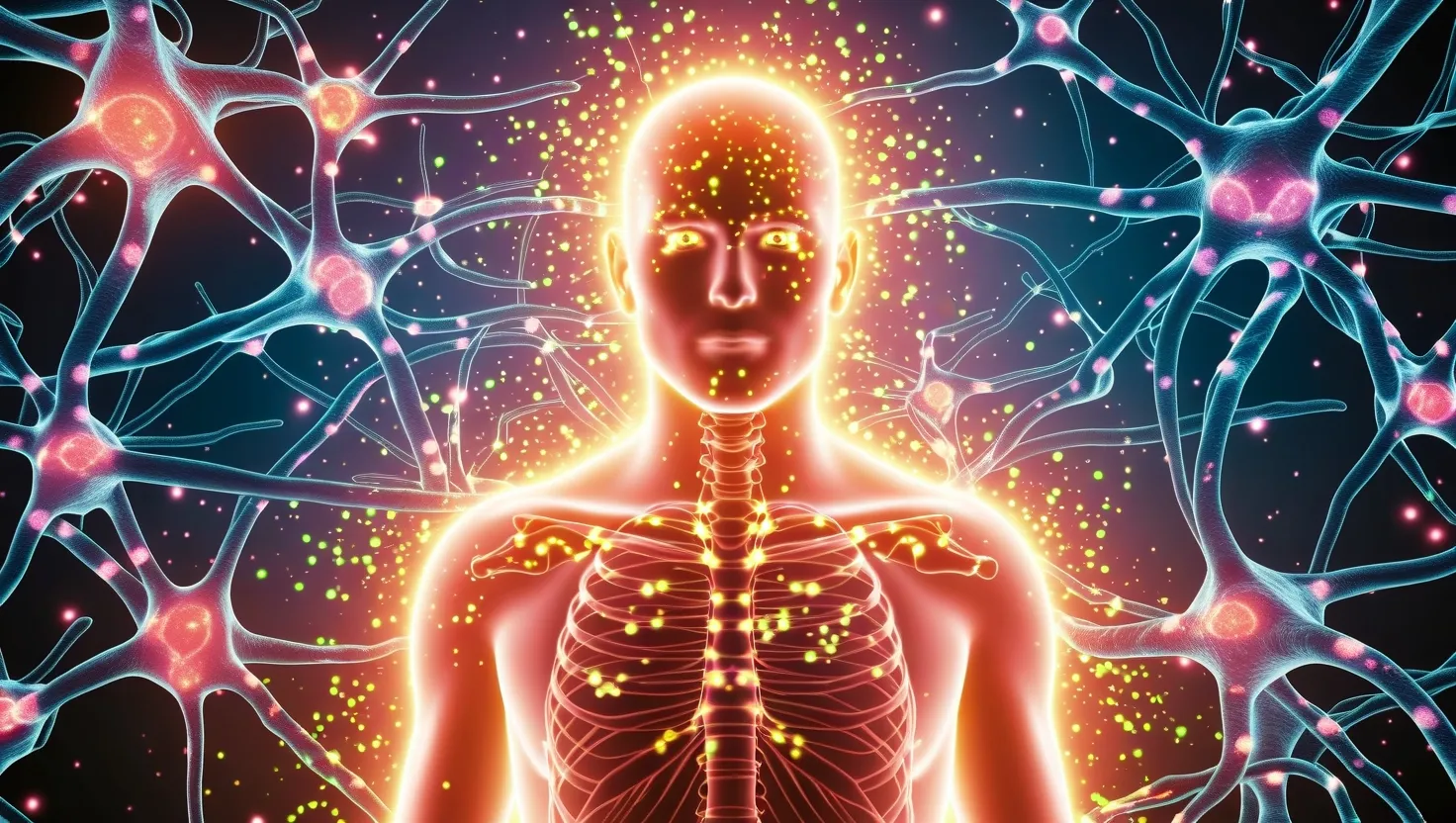
Imagine a world where every living cell in your body is emitting a faint, yet significant, glow. This isn’t just a metaphor; it’s a scientific reality that has been fascinating researchers for decades. The phenomenon is known as biophoton emission, and it suggests that our bodies are constantly broadcasting ultra-weak light signals into the universe.
To understand this better, let’s delve into the basics. Biophotons are photons emitted by living cells, distinct from the more familiar bioluminescence seen in fireflies or glowworms. These photons are produced as by-products of cellular metabolism and are emitted in the ultraviolet and visible ranges of the electromagnetic spectrum. The intensity is incredibly low, typically just dozens of photons per second per square centimeter of cell culture, but this doesn’t diminish their potential significance.
One of the pioneers in this field, Dr. Fritz-Albert Popp, described our bodies as “beings of light” due to this biophoton emission. According to his research, every cell in our body emits a radiation of light that forms an intricate, highly organized system of communication. This communication is not just within our own bodies but could potentially extend to other living organisms and even the environment around us.
The mechanism behind biophoton production is still not fully understood, but it is believed to involve various molecular processes within cells. These processes can emit photons, which are then transported to the cell surface by energy-carrying excitons. This is somewhat similar to how energy is transferred during photosynthesis in plants.
But what if these biophotons are more than just random emissions? What if they are actually a form of cellular communication? Researchers like Sergey Mayburov have been studying the patterns of biophotons emitted by cells to see if there is any discernible structure. Mayburov’s work suggests that biophoton streams consist of short, quasiperiodic bursts that are remarkably similar to those used in binary data transmission. This could mean that cells are using these light signals to communicate with each other in a way that is both efficient and resilient to noise.
Experiments have shown some intriguing effects of biophotons on cellular behavior. For instance, biophotons from a growing plant can increase the rate of cell division in other plants by as much as 30%. This is a significant increase, especially considering that ordinary light, even at much higher intensities, cannot achieve the same effect. Similarly, biophotons from growing eggs can encourage the growth of other eggs of a similar age, while biophotons from mature eggs can hinder or even stop the growth of younger eggs.
The role of biophotons in electromagnetic processes within the body is also a subject of intense study. It appears that all living cells generate biological electromagnetic fields, which play a crucial role in cell signaling and overall cellular processes. These fields are not just passive by-products; they are essential for the functioning of DNA and other cellular machinery.
Dr. Popp’s work took this idea further by suggesting that biophotons could be part of a quantum-coherent system within the body. When cells are healthy, their biophoton emissions are highly coherent, meaning they are synchronized with each other. This coherence allows these light particles to communicate and give feedback to each other, forming a complex network of light-based communication.
But what about the implications of this theory? If biophotons are indeed a form of communication, could we learn to control them consciously? The idea might sound like science fiction, but it’s an area that some researchers are exploring. Imagine being able to use your inner light to communicate across vast distances or even influence physical reality. It’s a concept that blurs the lines between biology, physics, and perhaps even the mystical.
The connection between biophotons and our overall health is another fascinating aspect. Healthy foods, for example, have been found to have more coherent biophoton emissions compared to junk food. This suggests that the quality of our diet could influence the health of our cellular communication system. Moreover, research has shown that people with serious health concerns often have biophoton emissions that are less coherent and less in harmony with natural biological rhythms.
Biophotons also follow biological rhythms, including daily, weekly, monthly, and yearly cycles. In healthy individuals, these emissions are in harmony with these rhythms, while in those with health issues, the coherence and natural rhythms are disrupted. This disruption could be seen as a form of “scrambled” communication within the body, leading to various health problems.
The potential applications of biophoton research are vast. For instance, biophoton detection could be used as a non-invasive tool for early malignancy detection. Studies have shown that biophoton emissions can differ significantly between healthy cells and cancerous ones, providing a possible new method for diagnosing diseases.
In conclusion, the world of biophotons is a mysterious and intriguing one. It challenges our conventional understanding of cellular communication and opens up new avenues for research into the interconnectedness of living organisms. Whether or not we can consciously control these biophoton broadcasts remains a topic of speculation, but one thing is clear: our bodies are indeed “beings of light,” and this light is more than just a passive by-product of cellular activity. It is a dynamic, coherent system that could hold the key to understanding many of the mysteries of life and health.
As we continue to explore this phenomenon, we may find that the boundaries between biology, physics, and even spirituality are not as clear-cut as we once thought. The idea that every cell in our body is part of a grand, luminous orchestra playing across the universe is both captivating and humbling. It reminds us that there is still so much to discover about the intricate web of life and our place within it. So, the next time you look at yourself, remember that you might just be a walking light bulb, quietly illuminating the quantum web of life.