Did NASA Fool Us with a Staged Moon Landing or Was It All Real?
Debunking the Moon: From Shadows to Laser Beams—The Truth Behind One of History’s Big Debates
The Moon landing conspiracy theory has lingered in public consciousness for decades, captivating imaginations and sparking debates across generations. Despite an avalanche of evidence proving otherwise, this theory still attracts attention and believers. Let’s dive into where it all started, the main claims, and the solid counter-arguments that have emerged over the years.
So, the whole Moon hoax thing really kicked off in the mid-1970s, a time when trust in government was at a low ebb. One of the early voices in this space was a former US Navy officer, who claimed to have the inside scoop on a major government cover-up. He argued that NASA couldn’t safely land astronauts on the Moon by the 1960s deadline set by President John F. Kennedy. So, he said, the whole thing was staged in a film studio. Intriguing, right?
One of the big talking points for conspiracy theorists is the shadows in the Moon landing photos. They argue that the inconsistencies indicate multiple light sources, suggesting a studio setup. But this doesn’t hold up under scrutiny. The shadows actually make perfect sense when you consider perspective and the three-dimensional lunar landscape. It’s exactly how shadows behave on Earth when you have varied elevations and angles.
Another favorite argument is the absence of stars in the photos taken on the Moon. The naysayers claim this proves the pics were taken in a studio. But here’s the thing: the astronaut’s cameras were set to capture the brightly lit lunar surface, making the stars too faint to appear. It’s like taking a photo on a sunny day on Earth; the bright daylight overpowers the faint light from distant stars.
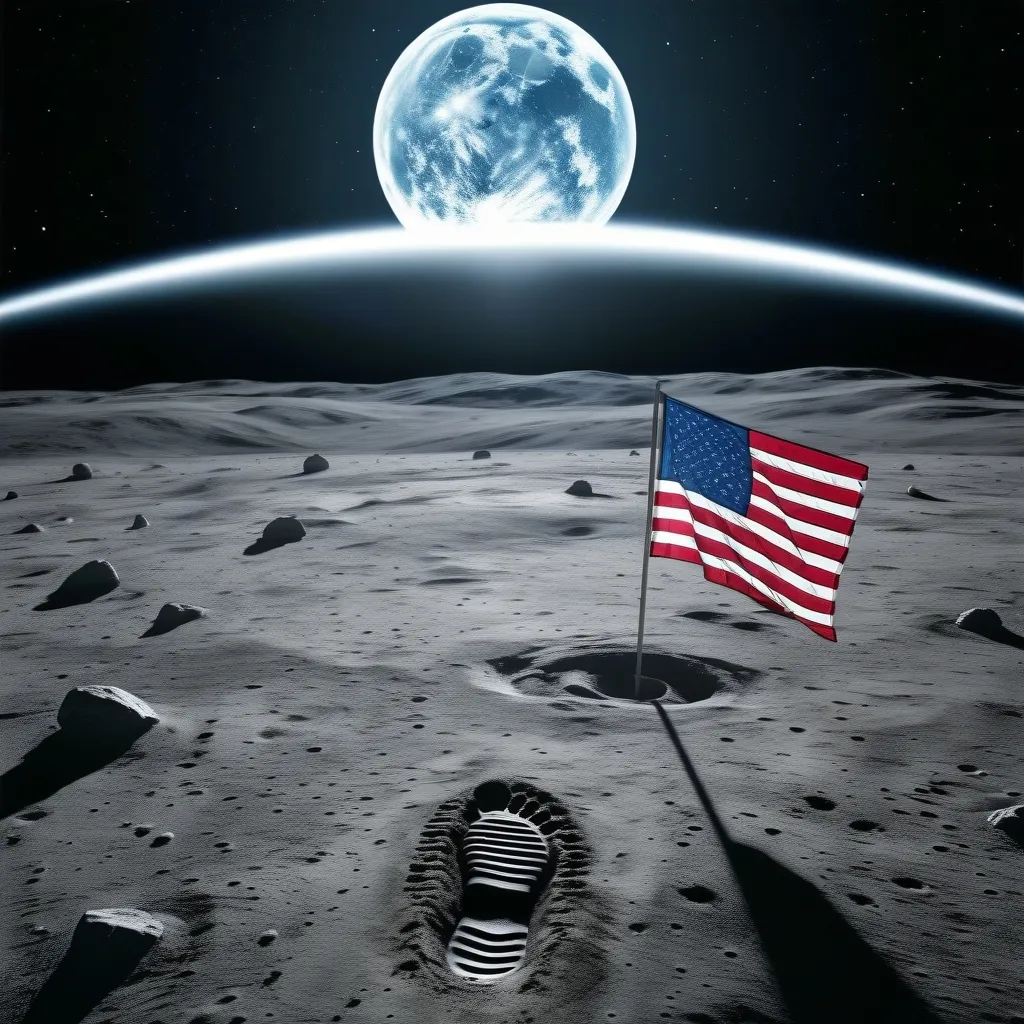
Then there’s the waving American flag, which some point to as evidence of wind in a vacuum, like, how could that even happen? Simple answer: it wasn’t waving because of wind. The astronauts had just planted it and were twisting the flagpole to get it upright, making it move.
Radiation also comes up a lot in these debates. Some argue that astronauts couldn’t have survived passing through the Van Allen radiation belts, which are indeed filled with highly energetic charged particles. But NASA wasn’t flying by the seat of their pants here. The spacecraft had an aluminum shell for protection, and they picked a trajectory that cut down the time spent in those radiation-heavy zones. The actual exposure levels were recorded and found to be safe.
Let’s talk evidence. Moon rocks. Yep, those rocks brought back from the Moon have been verified by labs worldwide. They’ve got characteristics that just can’t be faked or found on Earth. Additionally, NASA’s Lunar Reconnaissance Orbiter (LRO) has snapped high-res photos of the Moon’s surface, showing the remains of Apollo missions. The landing sites, descent modules, and even the astronaut’s footprints are captured in these images, giving us visual proof that humans were there. Plus, other countries’ spacecraft from China, India, and Japan have also confirmed these findings.
Now, one of the coolest pieces of evidence is the lunar laser ranging retroreflector array left by Apollo 11. This device reflects laser beams back to Earth, letting scientists measure the Moon’s distance with mind-blowing accuracy. It’s been working for over 50 years now. If that’s not proof, I don’t know what is.
Public opinion, however, is a tricky beast. Despite all this evidence, a good chunk of folks remains skeptical. Polls indicate that 5-10% of Americans and up to 57% of Russians think the Moon landings were faked. Why? A mix of distrust in government, media influence, and popular culture playing up these theories. Movies and documentaries have a knack for turning these conspiracies into sensations, feeding their longevity.
This brings us to the role of critical thinking. With the endless flow of information today, having critical thinking skills is crucial. Misinformation spreads like wildfire, giving conspiracy theories fertile ground to grow. By diving into the scientific principles and evidence behind historic events, we can better spot fact from fiction.
The Moon landing conspiracy is a prime case of how misinformation can stick around. But when we look closely at the evidence and understand the context, it’s clear the Moon landings were real. The Apollo program’s achievements aren’t just remarkable; they’re a testament to human ingenuity and the power of scientific teamwork.
Sure, the idea of faking the Moon landing might sound intriguing, but it’s a flawed premise. The evidence—from Moon rocks to the retroreflector—speaks loud and clear. As humanity continues to push boundaries in space exploration, it’s essential to stay grounded in facts and critical thinking, rather than getting lost in speculation and misinformation.