How Big Are the Universe's Giants and What Secrets Do They Hold?
From Brown Dwarfs to Hypergiants: Exploring the Tiniest and Mightiest Titans of Our Cosmos
Journey to the Largest Stars in the Universe
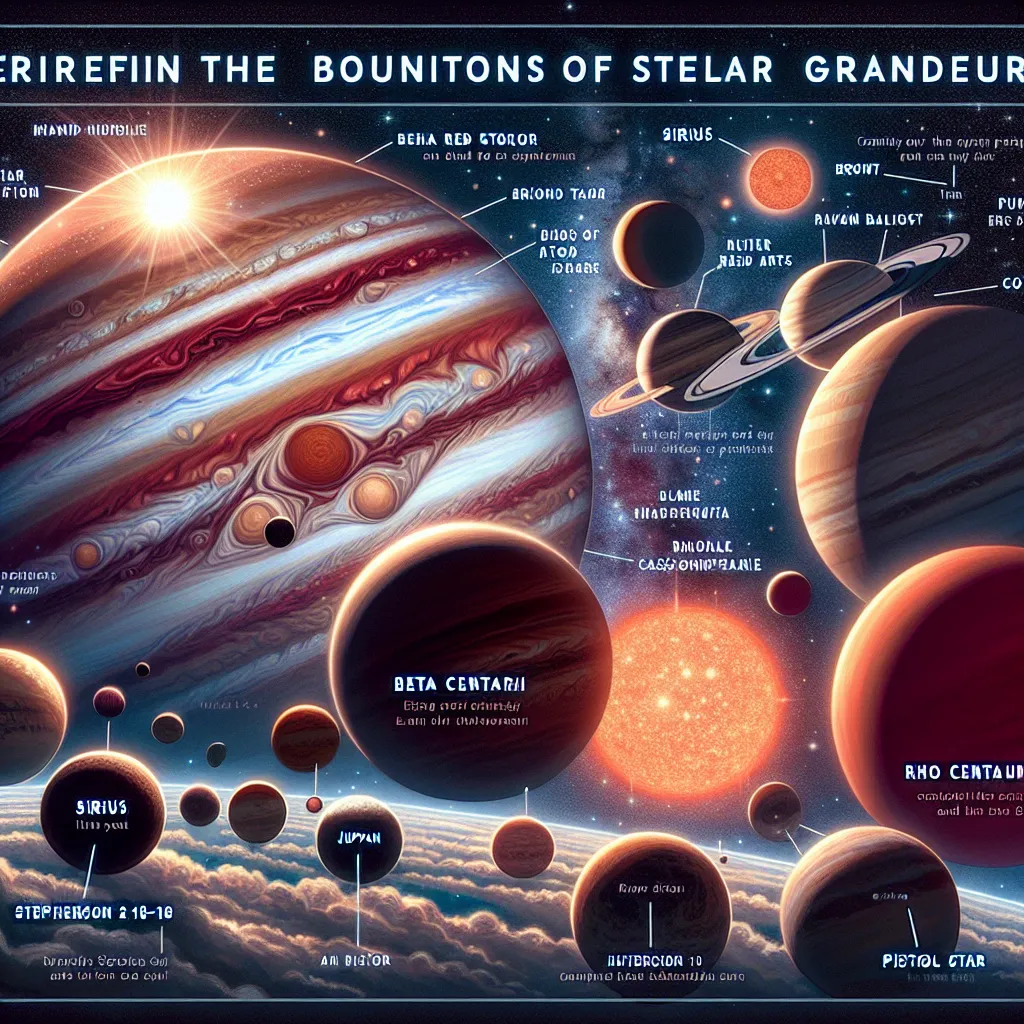
Let’s kick off our cosmic journey from Earth, just to get a sense of scale. Imagine Jupiter, the giant of our solar system, being 11 times larger and 317 times more massive than Earth. Yet, compared to the Sun, Jupiter is just a whiff of gas.
The real contenders for stardom start with brown dwarfs—failed stars that never quite made it. Despite being up to 90 times the mass of Jupiter, they just don’t have the oomph to become proper stars. Brown dwarfs hover in between, glowing a bit, but never really shining.
Now, let’s talk about the stars that have crossed that crucial threshold into stardom. The smallest stars are red dwarfs, just about 100 times the mass of Jupiter, squeaking past the mass needed to ignite hydrogen fusion. They shine dimly and live impressively long lives, up to ten trillion years. One of our closest neighbors, Barnard’s Star, is a red dwarf, but you need a telescope to spot it.
Next up are stars like our Sun. It owns 99.86% of the solar system’s mass and is vastly brighter and hotter than red dwarfs. Stars like Sirius are even more extreme; double the mass of our Sun but shining 25 times brighter.
Let’s go bigger. Stars around 10 times the mass of the Sun burn incredibly hot, with surface temperatures soaring to 25,000 degrees Celsius. Beta Centauri has two such stars, each shining 20,000 times brighter than the Sun but living for just a brief 20 million years.
The heaviest star we know is R136a1 with a staggering 315 solar masses, blazing nearly 9 million times brighter than the Sun. Despite this, it measures only about 30 times the Sun’s size—a luminary barely held together by gravity, shedding colossal amounts of mass every second. Such massive stars are rare, often forming by the merger of smaller stars.
When stars near the end of their hydrogen-burning phase, they expand into red giants. For example, Gacrux, just a bit heavier than our Sun, balloons to 84 times its radius. The Sun itself will swell to 200 times its current size in its final phase, swallowing the inner planets.
But the largest stars of all are hypergiants. These beasts have enormous surface areas and throw off their mass via powerful stellar winds. Pistol Star, a blue hypergiant, is 25 times the Sun’s mass but expands to 300 times its size. Rho Cassiopeiae, a yellow hypergiant, is even larger—500 times the Sun’s radius and shining 500,000 times brighter.
Red hypergiants top the size chart. One of the largest contenders we know is Stephenson 2-18. It’s estimated to be around 2150 times the size of the Sun, making our star look like a speck of dust by comparison. Just traveling around this colossal star at light speed would take nearly nine hours!
These giant stars will eventually explode in spectacular supernovae, recycling their material into the next generation of stars. The universe is vast and packed with titanic wonders stretching our imaginations to their limits.
If you’re fascinated by this cosmic scale, there’s an app, “Universe In A Nutshell,” where you can explore from tiny particles to gargantuan stars. It’s an exciting way to dive deeper into the vastness of our universe.