Minnesota's Devil's Kettle: The Waterfall That Has Stumped Scientists for Decades
Discover the Devil's Kettle, a Minnesota waterfall that swallows half a river with no trace. Science has no answer yet. Read the full mystery here.
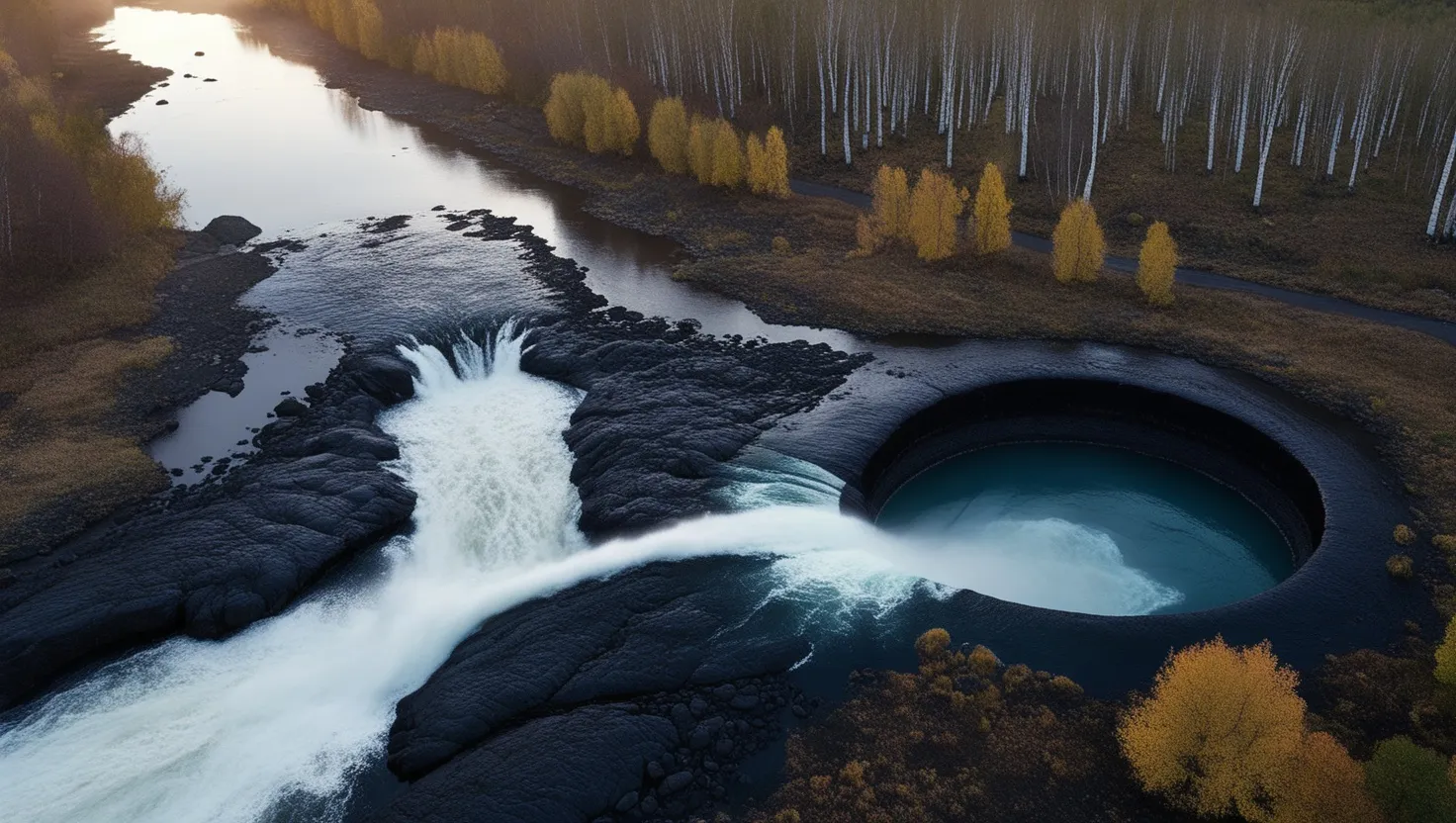
There is a waterfall in northern Minnesota that has been quietly humiliating scientists for decades. It sits in Judge C.R. Magney State Park, on the Brule River, surrounded by birch trees and unremarkable hiking trails. Tourists photograph it. Rangers explain it to school groups. And every year, half a river disappears into a hole in the ground and is never seen again.
That hole is called the Devil’s Kettle.
The setup is almost theatrical. The Brule River reaches a two-tiered rock ledge and splits. On the left side, water drops about fifty feet into a pool and continues downstream toward Lake Superior, behaving exactly as a river should. On the right side, the water pours into a circular pothole carved into ancient volcanic basalt. It falls in. And then it is gone. No downstream return. No detectable plume in the lake. No signal from tracers, dye, or the dozens of ping-pong balls that researchers have fed into the mouth of the hole over the years. Nothing comes back.
Ask yourself this: where does water go when it stops being a river?
The question sounds like a riddle, but it is a real hydrological problem that has resisted every tool modern science has applied to it. Evaporation cannot account for the volume. The surrounding rock is not porous limestone that slowly drinks water and redistributes it. The basalt is dense and volcanic, the kind of rock that geologists would normally describe as a poor candidate for hidden drainage systems. And yet the water vanishes.
“The most beautiful thing we can experience is the mysterious. It is the source of all true art and science.” — Albert Einstein
To understand why this is so strange, you need a basic picture of how rivers work. Water flows downhill. When it disappears underground, it has to go somewhere — through fractures, into aquifers, or through cave systems — and it almost always resurfaces. Hydrologists trace this movement with fluorescent dyes. You pour the dye in upstream, set up detectors downstream, and the dye shows up where the water goes. It is one of the most reliable tools in the field.
The dye went into the Devil’s Kettle in the 1960s. Nothing showed up. Researchers tried again in the 2000s with better instruments and more sampling points. The result was the same. The dye, along with the logs, balls, and whatever else went in, simply ceased to exist in any detectable form.
Now think about the scale. This is not a trickle. At peak spring flow, the Kettle swallows half the volume of the Brule River. That is thousands of gallons per minute pouring into a hole. The river below the falls shows no measurable gain from that missing water. The downstream flow accounts only for the half that went over the visible falls. The other half is a ghost.
The most plausible scientific explanation involves fractures in the basalt. Glacial meltwater, moving under enormous pressure thousands of years ago, drilled the pothole and may have carved a network of cracks below it. The water from the Kettle might move through those fractures very slowly, spread across a wide area, and seep into Lake Superior through the lake bed rather than through any visible spring. A diffuse seep over a large area would be nearly impossible to detect with conventional methods.
But here is the problem with that explanation: it has never been confirmed. A diffuse seep still produces a chemical or thermal signature. Lake Superior is well-studied. Its bed near the Brule River outflow has been surveyed. No anomaly matching the expected output has been found.
“Nature uses only the longest threads to weave her patterns, so that each small piece of her fabric reveals the organization of the entire tapestry.” — Richard Feynman
A more radical theory suggests the water enters a deep underground path that runs under the lake bed and exits far offshore, in water too deep and too cold for the signal to rise above background noise. This would require a hydraulic conduit — essentially a natural pipe — efficient enough to carry half a river without losing pressure or direction over a potentially very long distance. The geology of the region does not show any known cave system that could do this. The rock is not karst. It does not form tunnels the way limestone does. The idea requires a geological structure that nobody has found evidence of.
What makes the Devil’s Kettle genuinely strange, as opposed to just poorly studied, is that it sits in a well-mapped, accessible, heavily visited state park. This is not some remote canyon studied once and forgotten. Rangers have watched it for generations. University teams have run controlled experiments. The site is not mysterious because nobody has looked. It is mysterious because everyone who looks comes away without an answer.
Have you ever noticed how the things closest to us are sometimes the hardest to explain?
There is a broader point here about the limits of scientific confidence. Hydrology is not a young field. We can map aquifers thousands of feet below the surface, trace water through cave systems spanning multiple states, and detect groundwater movement through solid rock using isotope analysis. The tools are genuinely impressive. And yet a single pothole on a state park trail in Minnesota has defeated every one of them.
“Equipped with his five senses, man explores the universe around him and calls the adventure Science.” — Edwin Hubble
Part of what makes this so uncomfortable for researchers is that the anomaly is local and self-contained. The Brule River above the falls is ordinary. The park around it is ordinary. The geology is well-understood in general terms. The weirdness is concentrated entirely in one circular hole about three feet across. That specificity should make it easier to solve, not harder. A mystery spread across a hundred miles of terrain is hard to study. A mystery you can stand next to and watch should be solvable. The fact that it is not says something interesting about the gap between what we can observe and what we can explain.
A 2017 analysis by Minnesota state geologists attempted to settle the question by measuring stream flow upstream and downstream with more precision than previous studies. They found something surprising: when they accounted carefully for the full water budget, the downstream flow matched expectations better than the old measurements suggested. Their interpretation was that earlier measurements of the “missing” water had been imprecise, and that the Kettle’s output likely emerged through the Brule’s streambed and banks as diffuse groundwater before reaching Lake Superior.
This sounds like a resolution. But it is not quite one. The dye still never appeared. The ping-pong balls never surfaced. The streambed diffusion model explains the water budget on paper without producing the physical evidence that any good tracer study demands. You can balance the numbers without knowing where the water actually goes.
So what do we actually know? We know the water goes in. We know it does not come out in any identifiable, concentrated flow. We know the volume is large. We know the rock is old, hard, and fractured in ways that are difficult to map completely. We know that every tracer study has returned a negative result. And we know the hole is still there, still swallowing its share of the river, still offering no explanation.
“The most incomprehensible thing about the world is that it is comprehensible.” — Albert Einstein
For most of us, a waterfall that swallows half a river and gives nothing back is a satisfying mystery — the kind that makes a hike more interesting and a photograph feel slightly more charged. For a hydrologist, it is something closer to a splinter. The field has the vocabulary and the instruments to explain how water moves through the earth. The Devil’s Kettle refuses to cooperate with that vocabulary.
What the Kettle really exposes is how confidently we assume the earth is fully legible. We have satellites, ground-penetrating radar, isotope labs, and fluorescent dye bright enough to trace through miles of solid rock. We have mapped the ocean floor and the surface of Mars. And there is a hole in Minnesota, three feet wide, that we cannot read.
The water goes in. The science, for now, stops at the edge.