5 Things the Sun Does That Scientists Still Cannot Explain
Discover 5 unsolved mysteries about the Sun — from its hotter-than-surface corona to the Faint Young Sun Paradox. Science has questions. Read to explore them.
The Sun is 93 million miles away, and most of us only think about it when we forget sunscreen. But up close — scientifically speaking — our star is one of the most confusing objects in the known universe. Not because it’s complicated in an obvious way, but because it keeps breaking its own rules.
Let’s start with something that should be impossible.
The Atmosphere That’s Hotter Than the Surface
Imagine standing next to a campfire. The closer you get, the hotter it is. Move away, and it cools down. That’s how heat works — it flows outward and weakens with distance. Every physics teacher in the world will tell you the same thing.
The Sun didn’t get that memo.
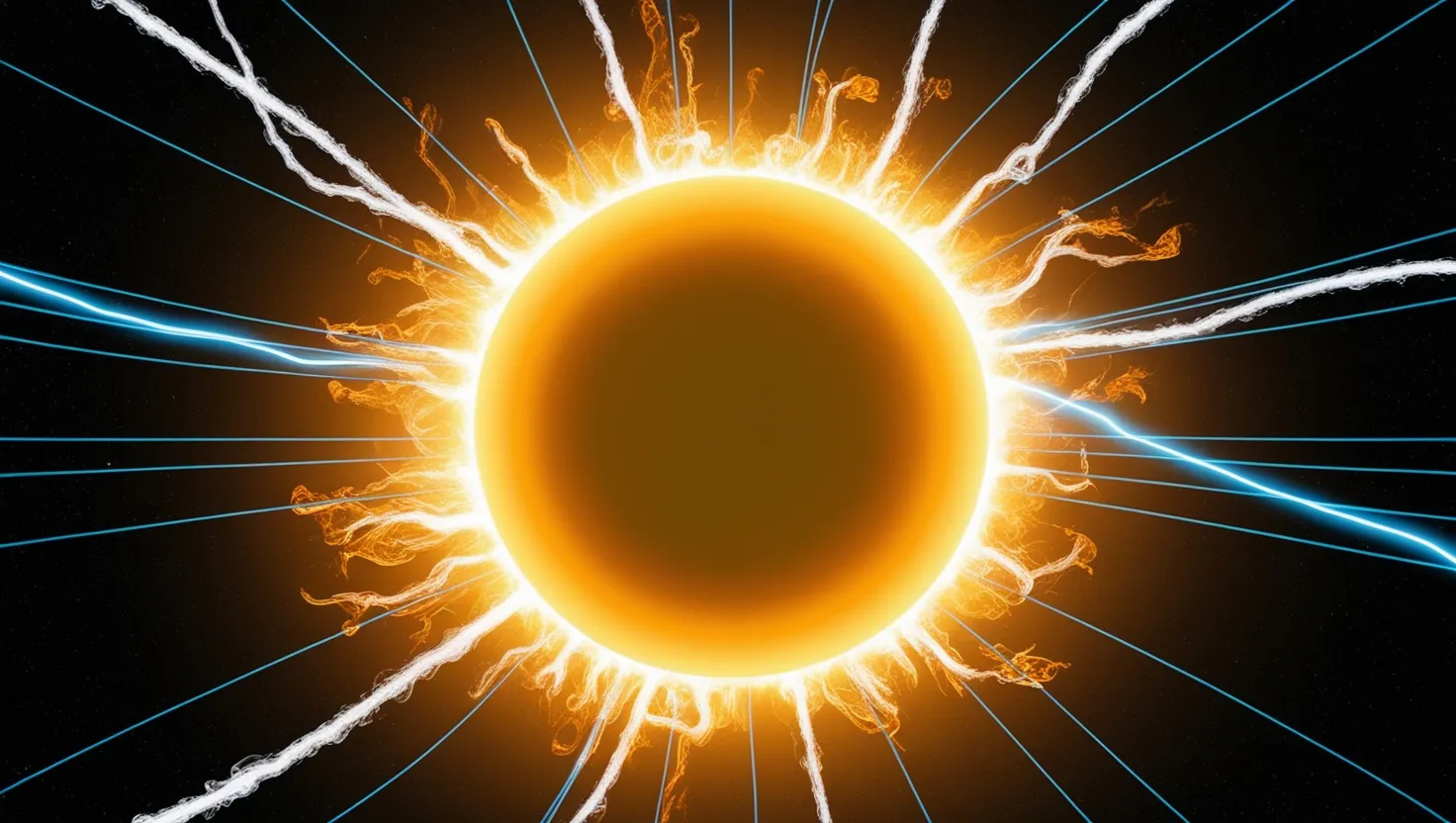
The Sun’s visible surface sits at around 5,500°C. That’s hot enough to melt literally everything humans have ever made. But float a little higher into the Sun’s outer atmosphere — the corona — and the temperature jumps to over a million degrees Celsius. Sometimes two million. Sometimes more.
This is not supposed to happen. Heat should not increase as you move away from a heat source. It’s one of the foundational rules of thermodynamics, and the Sun appears to be violating it every single second of every single day.
So what’s going on?
Scientists have two leading theories. The first involves something called nanoflares — tiny, rapid magnetic explosions happening constantly across the Sun’s surface. Each one is too small to detect individually, but collectively, millions of them might be dumping enormous energy into the corona. Think of it like this: one raindrop does nothing to a drought, but a trillion of them make a flood.
The second theory involves Alfvén waves — ripples that travel along magnetic field lines and carry energy upward, like sound waves carrying energy through air. The problem is that neither explanation fully accounts for the temperatures we actually measure. Both are probably contributing something. But the exact recipe? Still unknown.
“The most beautiful thing we can experience is the mysterious. It is the source of all true art and science.” — Albert Einstein
This isn’t a small gap in our knowledge. It’s a fundamental mystery about the star that keeps every living thing on Earth alive.
The Rhythm That Sometimes Goes Silent
Here’s something most people don’t know: the Sun has a heartbeat.
Every roughly 11 years, sunspot activity peaks and then drops back to near zero. Sunspots are dark patches on the Sun’s surface caused by intense magnetic activity. When there are many sunspots, the Sun is magnetically “loud.” When there are few, it’s relatively quiet. This cycle has been tracked since the 1600s.
But here’s the strange part — between 1645 and 1715, the sunspots essentially disappeared. For 70 years. Astronomers called this the Maunder Minimum, named after the husband-and-wife team who studied it. During this period, Europe experienced what historians call the Little Ice Age — brutal winters, frozen rivers, crop failures.
Does that mean the Sun directly controls Earth’s climate on that timescale? The relationship is debated. But the fact that the Sun’s own magnetic cycle can just… stop… is genuinely alarming from a physics standpoint.
The Sun’s magnetic field is generated by plasma — hot, electrically charged gas — moving around in complex patterns deep inside the star. That system, called the magnetic dynamo, should theoretically be too chaotic and fluid to switch off cleanly. It’s like expecting a boiling pot of water to suddenly freeze solid while still on the stove.
And yet it happened. And we don’t know why. We also don’t know when it might happen again, or for how long.
The Impossibly Sharp Boundary
Think of the Sun not as a uniform ball of fire, but as a layered structure — like an onion, if that onion were plasma at 15 million degrees in the center.
Deep inside the Sun, below the churning outer layer, there’s a zone where energy is transported by radiation rather than by convection. The boundary between these two zones is called the tachocline. It’s a thin shell sitting about 70% of the way out from the Sun’s center.
Solar physicists believe the tachocline is where the Sun’s magnetic cycle is born — where the magnetic dynamo gets its structure and rhythm. That’s important. But here’s the problem: based on everything we understand about fluid dynamics and plasma physics, that boundary should be fuzzy, thick, and spread out over time. It should have widened considerably over the Sun’s 4.6-billion-year lifetime.
Instead, it’s razor thin. Eerily so.
Something is holding it in place. Something is preventing it from spreading. What that something is — nobody knows. Several mathematical models attempt to explain it, but none has won broad acceptance in the scientific community. It’s a bit like finding a perfectly straight line drawn on a choppy ocean and not knowing who drew it.
“In physics, you don’t have to go around making trouble for yourself — nature does it for you.” — Frank Wilczek
The Wind That Keeps Speeding Up
The Sun is constantly exhaling. That’s not a metaphor — it genuinely releases a constant stream of charged particles called the solar wind, flowing outward in all directions at speeds between 400 and 800 kilometers per second.
Here’s what’s odd: as that wind travels away from the Sun, it should slow down. Just like how wind from a fan weakens the further you get from it.
The solar wind doesn’t slow down. In some regions, it actually speeds up. And parts of it remain surprisingly hot, even millions of kilometers away from the Sun, where there’s almost nothing around to keep it warm.
NASA’s Parker Solar Probe, which has made closer passes to the Sun than any spacecraft in history, discovered something strange in the magnetic field near the Sun’s surface — sharp, S-shaped reversals that scientists call “switchbacks.” These are rapid flips in the direction of the magnetic field that come and go in seconds.
The leading theory is that these switchbacks release energy into the solar wind, giving it that extra push. But how exactly the energy transfers from a magnetic field reversal into particle acceleration is still being worked out. The mathematics are genuinely difficult, and the observations keep throwing up new surprises.
What does this matter? The solar wind shapes the entire environment of our solar system. It’s responsible for auroras on Earth, and it can disrupt satellites, power grids, and communication systems. Understanding what drives it isn’t just academic curiosity — it has real consequences.
A Young Star That Should Have Frozen Everything
Now for the strangest one of all.
When the Sun was young — roughly 4 billion years ago — it was significantly dimmer than it is today. About 25% less luminous, by most estimates. Stars gradually brighten as they age, and our Sun is no exception.
Here’s the problem: with 25% less energy output, Earth should have been locked in a deep freeze. Calculations show the oceans should have been solid ice from pole to pole. No liquid water. No chemistry. No life.
But geological evidence — ancient rock formations, chemical signatures in minerals — tells a completely different story. Liquid water was present on early Earth. Rivers ran. Oceans sloshed. And somehow, incredibly, life got started.
This is called the Faint Young Sun Paradox, and it’s been bothering scientists since Carl Sagan and George Mullen first formally described it in 1972.
The most popular explanation is that early Earth had a much thicker blanket of greenhouse gases — carbon dioxide, methane, or both — that trapped just enough heat to prevent total glaciation. This is plausible. But the concentrations required to do the job clash with chemical evidence in ancient rocks that suggests CO₂ wasn’t nearly that abundant.
Could methane have done the heavy lifting instead? Maybe. There’s some evidence that early microbial life produced enormous quantities of methane. But that raises its own set of chemical problems.
“The universe is under no obligation to make sense to you.” — Neil deGrasse Tyson
What makes this paradox particularly important is what it implies for life elsewhere in the universe. If a planet around a young star had to survive this kind of early freeze, and Earth barely managed it — maybe with help from biology itself — then what does that say about the odds of life surviving around other young stars? It’s one of the quieter reasons why this unsolved question matters enormously to astrobiology.
What’s remarkable is that every one of these mysteries sits at the intersection of things we thought we understood — thermodynamics, fluid dynamics, stellar physics, atmospheric science. The Sun isn’t mysterious because it’s exotic. It’s mysterious because it keeps breaking rules that we use every day to build satellites, power plants, and physics textbooks.
We’ve mapped its surface in extraordinary detail. We’ve sent spacecraft closer to it than ever before. We’ve studied its light for centuries. And still, the star at the center of our solar system holds five fundamental secrets that no one has fully cracked.
That’s not a failure of science. That’s science working exactly as it should — asking better and better questions, and having the honesty to admit when the answers haven’t arrived yet.