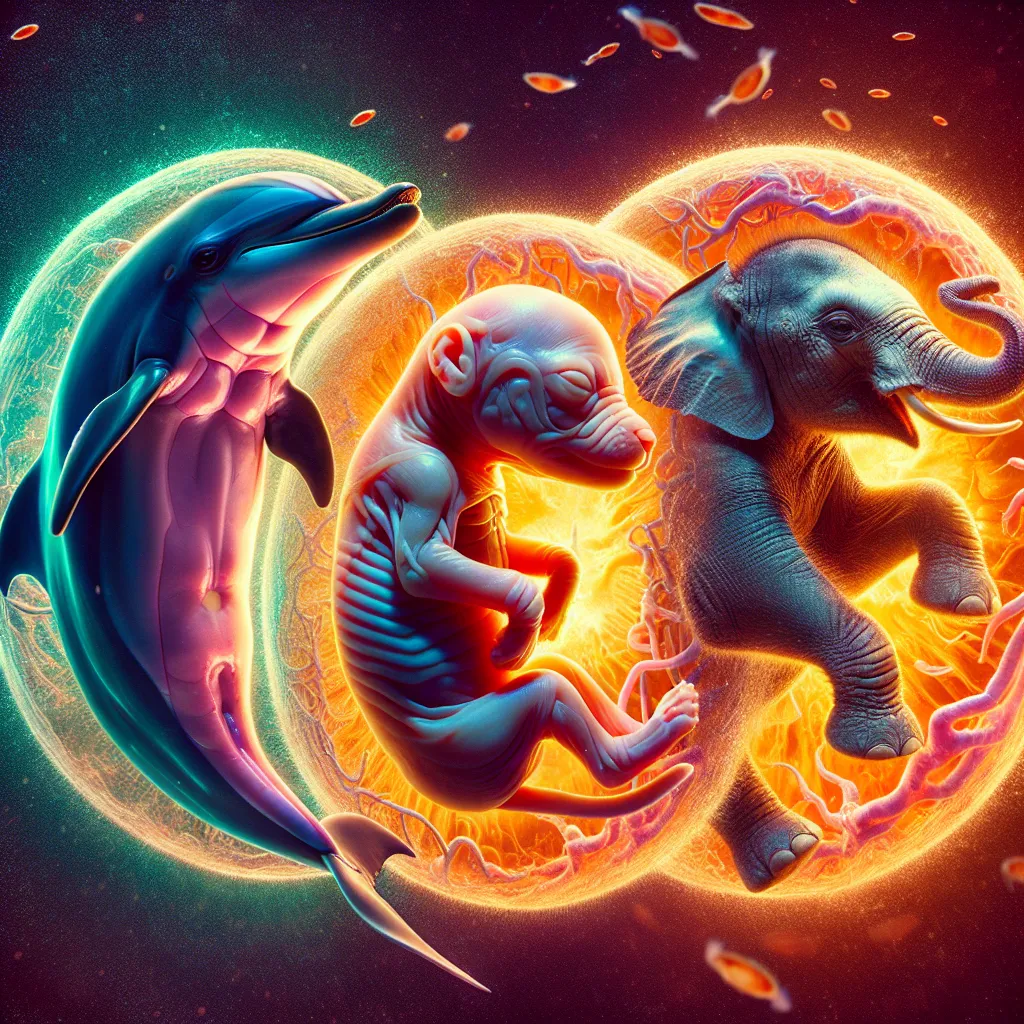
Life kicks off deep within the uterus as an embryo embarks on its wild ride to birth. It’s unclear which animal this might be, but it sure isn’t human. Get ready to witness an extraordinary close-up of how mammals morph from a common evolutionary start into wildly different adult creatures. Thanks to cutting-edge scientific research and digital wizardry, we can now peek inside the wombs of a dolphin, a domestic dog, and an elephant, revealing the awe-inspiring process of animal fetal development for the first time.
It all begins with a single fertilized cell, the spark that triggers the most perilous journey an animal will ever take. Just a speck in size, this cell divides and shapes itself into bones, nerves, and even a digestive system before it has fully formed. For mammals, it starts the same way: mating.
Take elephants, for instance. Their love affairs are epic, lasting nearly two years. Female elephants hang out with their girl squads and call out for a mate when in heat. The strongest males answer the call, fighting off rivals to mate multiple times over a few days. The mating ritual is unique; the male never penetrates the vagina, instead spraying a jet of sperm near the opening. The sperm then embark on a perilous journey, navigating tricky terrain and battling the female’s immune system to reach the egg.
The process of fetal development is a marvel. The sperm that survive fuse with the egg, kickstarting the creation of a new elephant. The fertilized egg, weighing less than a thousandth of a gram, eventually signals the mother to prep the uterus for the incoming baby, forming a blastocyst searching for a place to latch on.
For dogs, the drama unfolds faster. From conception to birth, it’s a whirlwind 63 days. The female retriever releases multiple eggs, mates quickly, and enters a “tie” stage where the penis locks inside the vagina. Inside her uterus, the eggs get fertilized and start their rapid transformation.
At just two weeks, the dog embryos begin gastrulation, where they fold in and start differentiating into specific cells, forming heads, tails, nerves, and skin. By the halfway mark, the heart starts beating, and the embryos are now grape-sized, developing sensory organs like eyes and ears, albeit with limited color vision. The puppies practice crucial behaviors like panting inside the womb and prepare for birth equipped with whiskers and a keen sense of smell.
Similarly fascinating is the dolphin’s voyage from land-dwelling ancestors to ocean mastery. It’s believed dolphins evolved from small, land-roaming creatures. Early embryos display leg buds, a nod to their past, yet transform quickly to adapt to life in water. As they develop, their nostrils shift atop their heads to become blowholes, and their tails become powerful flukes essential for swimming and defense.
Dolphins get unique adaptations for their aquatic life: hinged ribs for deep dives, fins for precision swimming, and a specialized melon in their forehead for echolocation. They can hear and see underwater like no other, employing a fine-tuned sonar system to navigate and hunt effectively.
Fast-forward to nearly a year into gestation, and these magnificent mammals are almost ready for birth. Dolphin calves are born fully alert, able to swim immediately, and nurse from milk rich in fat to promote rapid growth.
Elephant fetuses, on the other hand, take their sweet time. At four months, they’re just starting to show recognizable features, like the trunk. By the last few months, they undergo a growth spurt, emerging after 22 months, weighing around 120 kilos. Despite being born with an underdeveloped brain, the calf relies heavily on its mother and gradually learns to use its adept trunk.
In all this, we see echoes of common evolutionary roots and remarkable adaptations. Through advances in scanning technology and scientific insight, we’ve unlocked secrets of the animal kingdom, revealing this incredible journey to birth. Each species, from dogs to dolphins to elephants, showcases unique survival traits molded by millions of years of evolution, preparing them for life outside the womb.