Could Alien Volcanoes Be the Cradle of Extraterrestrial Life?
Exploring Alien Volcanoes: Could They Hold the Key to Extraterrestrial Life?
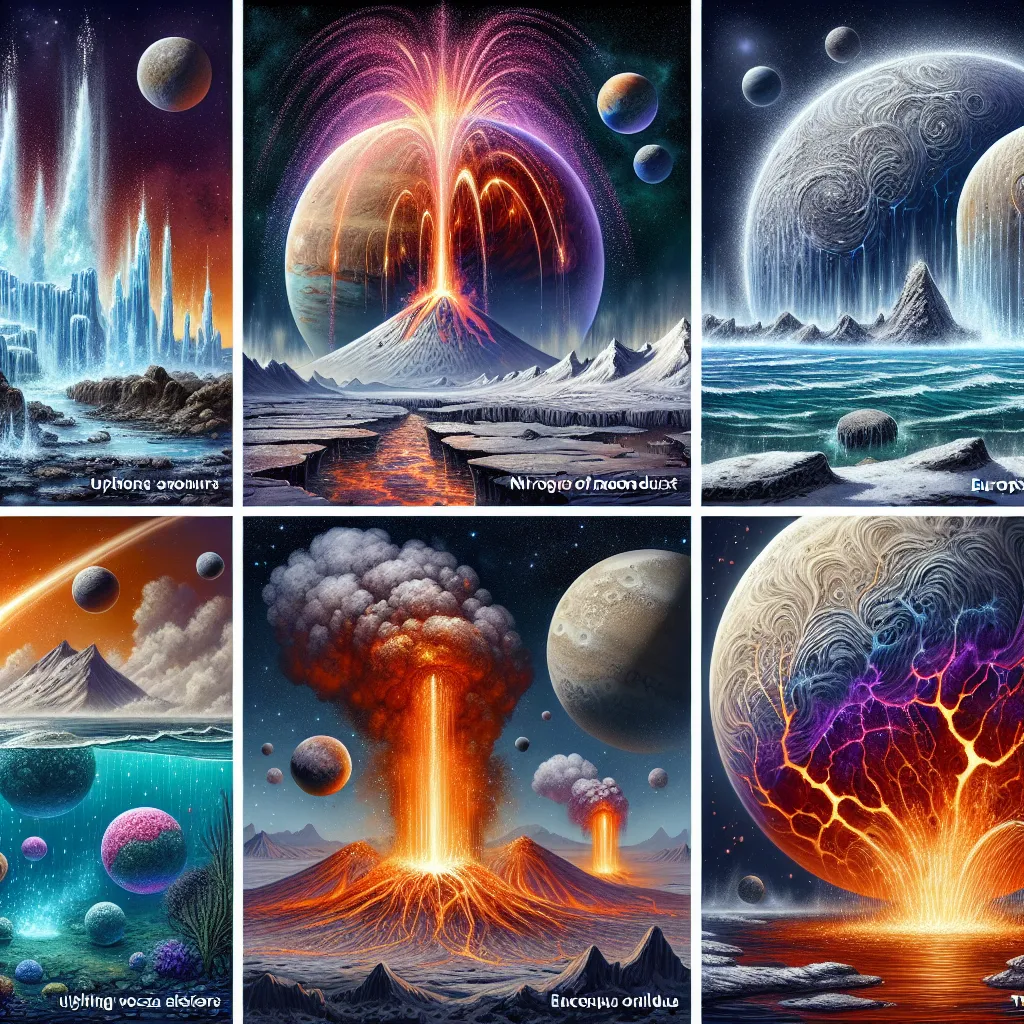
We often picture volcanoes as mountain-like structures spewing molten rock, but that’s just one version of volcanic activity. Imagine a world where volcanoes don’t spit out lava but instead release liquid nitrogen mixed with dust. Welcome to Triton, Neptune’s icy moon, orbiting far from the Sun at an astonishing 2.5 billion miles distance. When NASA’s Voyager flew by, this frozen world showed signs of peculiar activity. Instead of lava, Triton’s “geysers” blasted nitrogen and moondust. Crazy, right? Triton’s icy surface traps sunlight, creating a greenhouse effect that causes minor heat changes, enough to turn nitrogen ice into gas, which then erupts.
Not far off in the solar sense is Europa, one of Jupiter’s moons, blanketed in ice. Europa’s surface flexes under Jupiter’s gravitational pull, revealing an ocean beneath its icy crust. This ocean could be 60 miles deep, warmed enough by Europa’s rocky core to allow underwater eruptions. Such conditions seem favorable for life, as on Earth, where underwater volcanoes teem with living organisms. If life sparked here with the right ingredients, why can’t Europa host life in its dark, crushing depths?
Remember, moons aren’t just cold and lifeless. Saturn’s moons, Enceladus and Titan, present more intriguing cases. Enceladus astonished us with its ice plumes that escape into space, vital enough to feed Saturn’s distant E-ring. Beneath its icy surface lies an ocean where life could thrive. It’s not just water; complex organic molecules, salt, and even hydrothermal activity are possible here.
Titan, Saturn’s biggest moon, is equally fascinating. Imagine a moon with lakes of liquid methane, a thick atmosphere, and even storms. It has the essential chemicals life needs. Its volcanoes don’t spit lava; instead, they might spew icy slush and gases, creating an orange-hued atmosphere, perfect for, potentially, generating life.
Closer to Earth, Mars offers a historical perspective with its giant, now-extinct volcano, Olympus Mons, the largest in the solar system. Mars’s lack of tectonic movement made Olympus Mons grow to colossal heights. But these geological relics might soon serve another purpose. Lava tubes on Mars, similar to those in Hawaii, could become perfect shelters, protecting future Mars inhabitants from deadly radiation.
Volcanoes indeed showcase nature’s duality of creation and destruction. They shape the terrains and create environments that could potentially foster new life. From the ice volcanoes on Triton and Enceladus to the rugged relics of Mars, volcanoes hold intriguing possibilities for life beyond Earth. We thought Earth was unique with its volcanic life connections—but maybe, just maybe, other world’s volcanoes hold the key to extraterrestrial life.