Most of what we think of as “common sense” comes from living at human scale. I want you to imagine, for a moment, that common sense is a tool made for slow, dry land, human-sized life. Now we’re going to take that tool into storms, deserts, and polar oceans where it starts to fail in surprising ways.
Let’s walk through five natural phenomena that look like they are breaking the rules, and I’ll explain them as if we are two people talking at a table with a pencil and paper, not a physics lab with a whiteboard full of equations.
Let’s start with a simple question: how sure are you that you understand what lightning is?
You probably picture a jagged flash in the sky that lasts for a split second. Now imagine you are in a farmhouse during a storm and suddenly a glowing ball the size of a grapefruit floats through the window, drifts across the room, and quietly disappears. That is ball lightning.
You might think, “That sounds like a ghost story.” Scientists thought so too for a long time. Many early reports were ignored because they sounded too strange. But over the last century, so many consistent descriptions came in from pilots, sailors, soldiers, and villagers that it became very hard to dismiss. People on different continents, in different centuries, kept describing almost the same thing: a glowing sphere, usually the size of a fist to a football, lasting a few seconds, sometimes moving through closed windows or even walls, sometimes making a hissing sound, sometimes leaving a smell of sulfur.
Here is the strange part: we still don’t have a single agreed‑upon explanation. That alone is rare in modern physics.
Some ideas say ball lightning is a kind of burning vapor made from soil or metal dust blasted into the air by a lightning strike. Others say it is a “plasma bubble,” a knot of charged particles held together by its own electric or magnetic field. There are even ideas involving microwaves bouncing around in a pocket of ionized air.
But then we hit the weird reports.
People say they saw it drift through glass without breaking it. How can something made of matter pass through solid windows? One possible answer is: maybe it didn’t. Maybe the ball existed on one side, faded, and almost instantly reformed on the other side, giving the illusion that it went through. Our brains prefer smooth stories over messy ones, so we connect events into one object moving, instead of two separate flashes.
That’s an important idea here: some of what seems to “break physics” is actually our vision and memory trying too hard to make sense of very fast, very bright, very unfamiliar events.
Still, we can’t just blame it all on bad memory. A few rare videos and lab experiments seem to show ball‑like glows that last longer than normal lightning. They aren’t perfect matches, but they tell us that at least some version of this thing is possible in real air, with real electricity.
So where does that leave us? With a phenomenon that is probably real, definitely rare, and not yet pinned down. In an age where we send robots to Mars, having glowing balls we still cannot explain is a humbling reminder that the sky above our own heads still has surprises.
“Not only is the universe stranger than we think, it is stranger than we can think.”
— Werner Heisenberg
Have you ever had a belief that felt so obvious you didn’t even notice it was a belief? For most people, one of those is: “Heavy solid rocks don’t just start sliding on flat ground all by themselves.”
Now let’s go to Death Valley in California. There is a flat, dry lakebed called Racetrack Playa. Scattered across it are rocks, some small, some as heavy as a person. Behind many of them are long, straight tracks in the dried mud, like someone dragged each rock for tens or hundreds of meters.
No humans around. No animals. No tire marks. Just rock after rock with trails.
For decades, people argued about what did this. Wind? Ice? Pranks? Aliens? If the ground is hard and dry most of the time, and the rocks are heavy, your everyday sense of friction says they should just stay put.
So researchers did something very simple and very patient: they put GPS trackers on rocks, set up time‑lapse cameras, and waited. Years passed. Nothing happened. Then, one winter day, the “impossible” finally happened in front of the cameras.
Here is the key: the rocks move on days when three very specific things happen at the same time.
First, a thin layer of water covers the surface from rare rain or melted snow. Second, at night, that water freezes into a very thin sheet of ice, like a pane of glass, not a thick chunk. Third, the morning Sun and a gentle wind work together. The ice breaks into large, floating plates, still partly locked together, with the rocks frozen inside or pressed against them. As the wind pushes the ice sheets, the rocks ride along, slowly scraping the soft mud below.
The rocks do move, but very slowly, about the speed of a crawling baby. If you stood there for a few minutes, you might not even notice. But over several minutes or hours, they can slide tens of meters.
So the mystery isn’t magic. It’s timing.
It feels like common sense is broken here only because we rarely see all three conditions at once: shallow water, ultra‑thin ice, and just‑right wind on a perfectly flat surface. Our minds are tuned to everyday weather, not to fine‑tuned combinations that happen only once in a while, in very specific places.
Which raises a more interesting question: how many other “impossible” things are just waiting for the right mix of conditions we almost never notice?
Let’s leave the desert and fly to the dry grasslands of Namibia or parts of Australia. From the ground, the land just looks patchy. But from the air, something odd appears: huge fields of nearly perfect circles of bare soil, each circle ringed by taller grass. These are called fairy circles.
They look designed, like someone has stamped the grass with a giant polka‑dot pattern.
At first, people tried simple explanations. Maybe it’s a type of plant disease. Maybe it’s a toxic gas seeping from underground. Maybe it’s termites eating the grasses in certain spots.
Here’s where things get interesting: scientists studied the soil, the water flow, the plant roots, and the insects. They did not all agree on one story. Some found lots of termite activity in the bare spots and said, “See, termites are the engineers.” Others showed that you can get very similar ring patterns in computer models where plants compete for scarce water, even without animals at all.
So which is it? Bugs? Plants? Both? Something else?
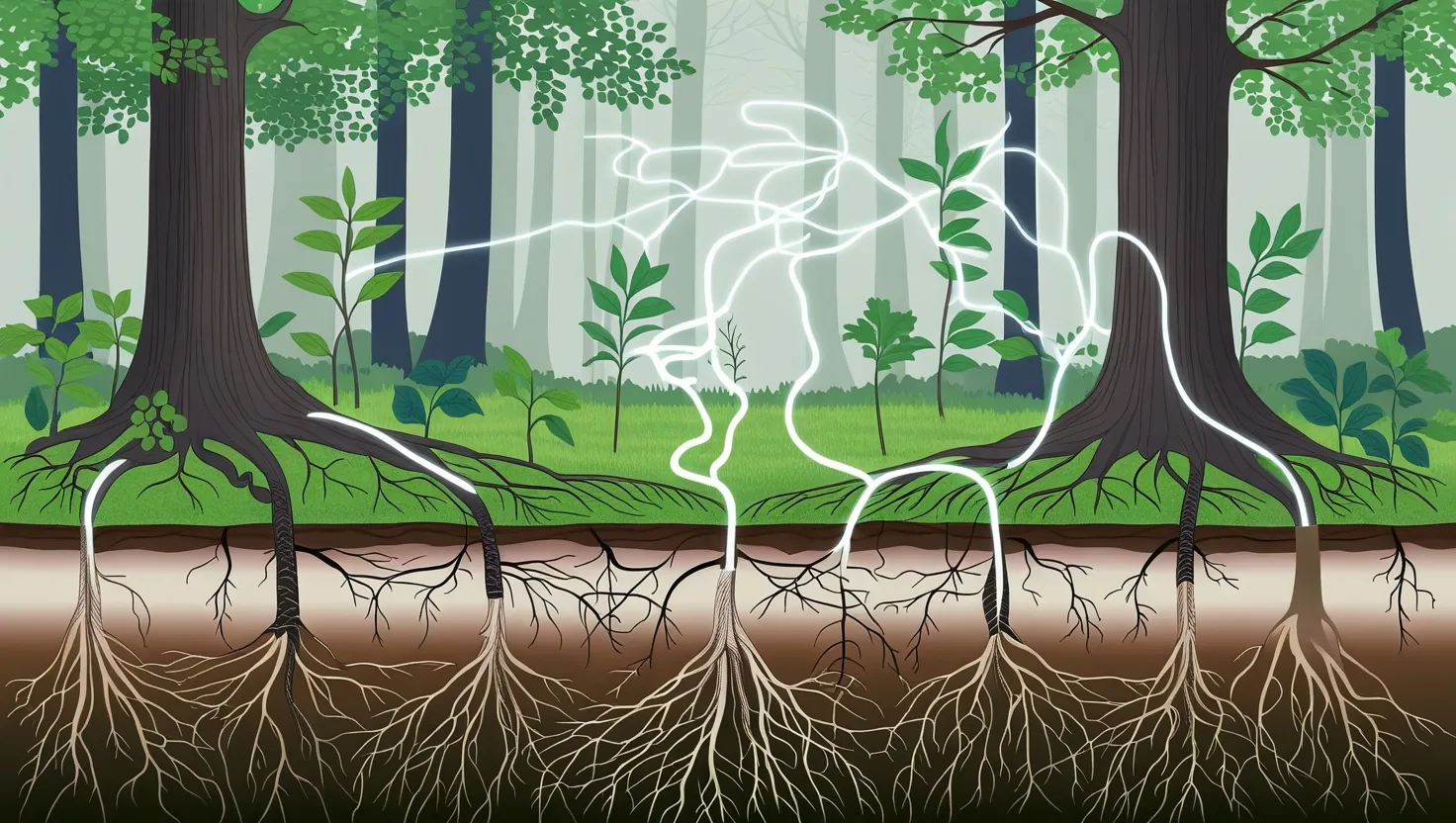
The answer that is slowly taking shape is more subtle. In some areas, termites seem to start or sharpen the pattern, by clearing plants and building underground structures that change how water collects. In other areas, even without termites, plants in a desert will “organize” themselves into patchy patterns because each clump of plants pulls water toward itself and starves the area around it. Over wide areas and long times, this produces repeating shapes like spots or stripes.
This self‑organization is the tricky part to accept. We are used to patterns coming from a designer: a farmer, an artist, a builder. But nature can make large‑scale order out of many very simple local rules.
Roots reach for water. Plants die where they cannot get enough. New shoots grow where there is just a bit more moisture. Over years, this dance of growth and death creates geometry that looks planned.
So fairy circles might not be a single “thing” with one cause. They might be a style of pattern that appears whenever dry ecosystems cross a certain tipping point. Termites might help in one region. Pure plant competition might do it elsewhere. The important, mind‑stretching part is this: you can get clean, almost mathematical designs from nothing more than each plant “selfishly” trying not to die.
Ask yourself: where else in life do we blame “mystery forces” when repeated simple actions could be quietly building complex results?
“Nature uses only the longest threads to weave her patterns, so that each small piece of her fabric reveals the organization of the entire tapestry.”
— Richard Feynman
Now let’s look at trees that seem to have hired a painter.
The rainbow eucalyptus looks almost fake in photos. Its trunk is streaked with bright green, orange, purple, and blue. People often assume the photos are edited. But if you visit one in person, you see the same thing: the bark peels away in strips, and the fresh layer underneath glows almost neon green. Over time, the exposed patches age and change color through shades of blue, purple, and rust, like a slow‑motion light show.
We know some pieces of the story. The tree sheds bark in sections, not all at once, which is already unusual. The new bark underneath has chlorophyll, the same green pigment in leaves, so the trunk can help with photosynthesis. That part makes sense in a rainforest where more surface area capturing light is an advantage.
But several basic questions are still not fully answered.
Why the sharp color shifts instead of a simple dull brown as it ages? Why the dramatic vertical streaks instead of random spots? Why such extreme brightness in the first place?
One idea is that the color changes act as a kind of growth diary. Newest bark is bright green and working hard like leaf tissue. As it ages, chemicals change and pigments shift, giving us the rainbow effect as a side‑effect of the tree managing its outer skin. Another idea is that the pattern may confuse or deter certain pests that rely on consistent color or texture to recognize their host.
Here is a thought I find helpful: not every beautiful thing in nature is made “for” beauty. Sometimes we are just lucky observers. Our eyes and brains love contrast and pattern. A tree trying to manage growth, disease, and sunlight might just happen to do those things in a way that looks like art to us.
But the puzzle remains: why this tree, in this way, and so extremely? We have mapped a lot of plant genes, but connecting specific genes to this kind of moving color show is still ongoing work.
So when you see a rainbow eucalyptus in a picture, remember that you are looking at living paint that is also doing work: breathing, defending, and growing. It is not a tree trying to be pretty. It’s a tree trying to live, and in doing so, accidentally writing a slow, vertical watercolor across its own body.
Now, let’s go from bright colors to bitter cold. Picture the ocean around Antarctica. You know ice forms on top of the sea. That seems simple. But there is a lesser‑known, underwater structure that looks like something out of a science‑fiction movie: the brinicle.
A brinicle is sometimes called an “icicle of death.” That name sounds a bit dramatic, but if you are a small sea creature on the seafloor, it is accurate.
Here is how it forms, in simple steps. When sea ice forms on the surface, the freezing process pushes most of the salt out of the ice crystals. That extra salt doesn’t disappear; it gets squeezed into channels and then drips back down into the water as very cold, very salty brine. This brine is both colder and denser than the water around it, so it sinks like a heavy, cold stream.
As it flows downward, it is so cold that it freezes the seawater it touches, forming a hollow tube of ice around itself. That tube keeps growing down until it reaches the seafloor, like an upside‑down icicle.
Inside that icy finger, supercold brine keeps draining. When it touches small animals like sea stars, worms, or slow‑moving creatures on the bottom, it can freeze them in place. Over time, this can create frozen patches of life on the seafloor.
From a distance, on video, it looks like a ghostly blue finger reaching down from the roof of the ocean.
Why does this feel like it breaks common sense? Because we don’t usually think of ice “growing downward into water.” Our day‑to‑day lives teach us that ice floats and stays on top. Here, the cold is moving in a narrow pipe, carried by salt differences and gravity, doing very targeted damage.
The detailed flow inside a brinicle, how the salt and heat move minute by minute, is still an active topic of research. Small changes in temperature and salinity can mean the difference between a stable brinicle and one that breaks or never fully forms. The broader ecological effects are also not fully known. Do brinicles create tiny frozen graveyards that change local food webs? Or are they too rare to matter much overall?
This is a case where a basic, school‑level fact—“saltwater freezes differently”—leads, in the real world, to shapes and effects we never see in a classroom glass of saltwater.
“Science is a way of thinking much more than it is a body of knowledge.”
— Carl Sagan
By now you might be asking: do these things really “defy” common sense, or do they just stretch it?
Here is the pattern I want you to notice.
Ball lightning shows us that even in something as studied as thunderstorms, there are rare, short‑lived events that our instruments still struggle to catch and explain. Sliding rocks show that simple forces like wind and ice can, in the right combination, do what we once thought required people or machines. Fairy circles show that groups of simple organisms following basic rules can build large, regular patterns without any “leader.” Rainbow eucalyptus trees remind us that biological solutions to survival problems can produce visual effects that feel artistic, even when no “art” is intended. Brinicles show that freezing is not just a flat surface process; it can create three‑dimensional structures that reach down and reshape tiny parts of the sea.
In each case, what feels like magic is usually a place where:
We don’t see the whole sequence of events, only the result.
We are used to thinking in one scale (seconds, meters, warm air), but the key action happens in another scale (minutes, microns, cold brine).
We bring human habits of thinking—stories, purpose, design—to systems that don’t have any of those.
So here is a question I’ll leave you with: if deserts, storms, and polar seas can still surprise trained scientists, how careful should we be when we say “That’s just common sense” in other parts of life?
The world is not trying to confuse us. It’s just not built to fit our everyday expectations. When we slow down, ask simple questions, and accept that strange things can still be real, we start to see that “defying common sense” is often just nature telling us, very gently, “Think again.”